Monday, November 13, 2006


Sunday, November 5, 2006


Tuesday, October 17, 2006
CHESS PIECE: KRAMNIK IS UNIFIED CHAMPION
World Championship Match, Elista, Russia
12-Game Match:
GM Vladimir Kramnik RUS 2743, 6.0-6.0
GM Veselin Topalov BUL 2813, 6.0-6.0
Playoffs:
1 Topalov vs Kramnik, Slav D18 ½ 47 moves
2 Kramnik vs Topalov, SemiSlav D45 1-0 45 moves
3 Topalov vs Kramnik, Slav D12 1-0 50 moves
4 Kramnik vs Topalov, SemiSlav D47 1-0 45 moves
Overall Tally:
Kramnik vs Topalov, 8.5-7.5
The Russian Vladimir Kramnik won the playoff match against Bulgarian Veselin Topalov with a score of 2 wins 1 draw 1 loss to crown himself as the undisputed World Chess Champion.
Topalov did not roll over and play dead. On the contrary he fought well and scored a mighty victory in the 3rd game.
Topalov,Veselin (2813) - Kramnik,Vladimir (2743) [D12]
WCh Unification Playoffs Elista (3), 13.10.2006
1.d4 d5 2.c4 c6 3.Nf3 Nf6 4.e3 Bf5
[4...e6 5.Bd3 is game 7]
5.Nc3 e6 6.Nh4 Bg6 7.Be2
[7.Nxg6 hxg6 was used 3 times in their 12-game match - that's 25%. The interesting thing is that Topalov played white in games 9 (which he won) and 11, while he was black in game 12]
7...Nbd7 8.0–0 Bd6 9.g3 dxc4 10.Bxc4 Nb6 11.Be2 0–0 12.Nxg6 hxg6 13.e4 e5 14.f4
Topalov also used this move in games 9 and 11. You know, many years ago when Bent Larsen was rampaging over the chess world (this was in the late 60s, 70s and early 80s) many journalists wrote that his favorite move was h2-h4. During Mihail Tal's best years he boasted that his favorite maneuver was to play Ne5, sacrifice it soon on f7, and then mate his opponent. After this match perhaps f2-f4 will be forever connected to Topalov's name.
14...exd4 15.Qxd4 Qe7 16.Kg2
[16.e5?? Bc5 wins the queen]
16...Bc5 17.Qd3 Rad8 18.Qc2 Bd4 19.e5 Nfd5 20.Rf3 Nxc3
If Topalov was handling Black I'm sure he would have played 20...g5!?
21.bxc3 Bc5 22.Bd2 Rd7 23.Re1 Rfd8 24.Bd3
White is obviously building up for the f4-f5 advance.
24...Qe6 25.Bc1 f5
The pin on the e-file against white's rook makes this move possible, but white's attack is not that easily parried.
26.Qe2 Kf8 27.Rd1 Qe7 28.h4 Rd5 29.Qc2?! Nc4! 30.Rh1 Na3 31.Qe2 Qd7! 32.Rd1
Kramnik is milking the d-file for all its got.
32...b5 33.g4! fxg4 34.Rg3
Threat is 35.e6 followed by 36.Rxg4.
34...Ke7
Caption: position after 34...Ke7
Now Topalov breaks through.
35.f5! gxf5 36.Bg5+ Ke8
[36...Kf8 37.Bxf5! Qxf5 38.Rf1; 36...Ke6? 37.Bxf5+! Kxf5 38.Rf1+ Kg6 39.Qe4+ and mate]
37.e6 Qd6
Kramnik did not allow the brilliancy 37...Qc7 38.Rxg4! fxg4 39.Bg6+ Kf8 40.Rxd5! cxd5 (40...Rxd5 41.e7+! Bxe7 42.Qe6! forced mate) 41.Qxg4 Qe5 42.Qf3+ Kg8 43.Bf7+ Kf8 44.Be8+!
38.Bxf5!
Kramnik's idea was that 38.Bxd8? Kxd8 and it is he who is winning.
38...Rxd1 39.Bg6+ Kf8 40.e7+ Qxe7 41.Bxe7+ Bxe7 42.Bd3! Ra1 43.Qb2 Rd1 44.Qe2 Ra1 45.Qxg4! Rxa2+ 46.Kh3 Bf6 47.Qe6 Rd2 48.Bg6 R2d7 49.Rf3!
The end.
49...b4 50.h5 1–0
The fourth and final game was vintage Kramnik – he took a tiny endgame advantage and nursed it into a winning game, one which ended abruptly when a depressed Topalov blundered a rook and resigned.
Kramnik,Vladimir (2743) - Topalov,Veselin (2813) [D47]
WCh Unification Playoffs Elista (4), 13.10.2006
1.d4 d5 2.c4 c6 3.Nf3 Nf6 4.Nc3 e6 5.e3 Nbd7 6.Bd3 dxc4 7.Bxc4 b5 8.Be2 Bb7 9.0–0 Be7 10.e4 b4 11.e5 bxc3 12.exf6 Bxf6 13.bxc3 c5 14.dxc5 Nxc5!?
This position has already come up several times in the international tournament circuit, but Black has always castled his king to safety at this point. Topalov just grabs the pawn and dares Kramnik to prove him wrong.
15.Bb5+ Kf8 16.Qxd8+ Rxd8 17.Ba3 Rc8 18.Nd4
White's pawns are fragmented but he has the freer play. This is the type of position which Kramnik specializes in, and true enough he converts it into a winning position.
18...Be7 19.Rfd1 a6 20.Bf1 Na4 21.Rab1! Be4 22.Rb3! Bxa3 23.Rxa3 Nc5 24.Nb3! Ke7
I was watching this game live and the GM consensus was that Black is already out of the woods. Not quite.
25.Rd4! Bg6 26.c4 Rc6!? 27.Nxc5 Rxc5 28.Rxa6 Rb8 29.Rd1! Rb2 30.Ra7+ Kf6 31.Ra1 Rf5 32.f3 Re5
The threat is ...Bb1.
33.Ra3!
Probably overlooked by Topalov. Now the worse that can happen to white is a draw.
33...Rc2
[33...Bb1? 34.Rb3! Rxb3 35.axb3 and, with two connected passed pawns, White has an easy win]
34.Rb3 Ra5 35.a4 Ke7 36.Rb5! Ra7 37.a5 Kd6 38.a6 Kc7 39.c5 Rc3 40.Raa5 Rc1 41.Rb3 Kc6 42.Rb6+ Kc7 43.Kf2 Rc2+ 44.Ke3
White is probably winning, but there is no clear path yet if, for example, Black plays 44...e5, 45...Bf5 and 46...Be6. However, Topalov cracks and plays ...
44...Rxc5?? 45.Rb7+! 1–0
The controversies introduced into the match by Topalov’s manager, IM Silvio Danailov, brought a lot of unneeded tension and conflict into the match atmosphere. He accused Kramnik of going to the toilet too many times (at least 50, but this claim has been debunked) and therefore “might” be cheating, and later on took it one step further by charging that the 78% of the Russian’s moves matched the suggestions of the popular chess playing software “Fritz”.
The tactics were successful, and Kramnik rather stupidly fell into the trap and did not show up for the 5th game. This violated the rule that in controversies there should be no pussy-footing – either you tough it out (the grin and bear it method) or you put your foot down and completely refuse to give an inch. Anything in between and you get shafted – witness Kramnik’s forfeit loss in the 5th game, which FIDE would not invalidate.
He should have listened to Karpov, the last representative of the bygone age of Soviet chess, who advised Kramnik not to resume the match after the forfeit loss and walk away. Of course you cannot expect anything else from Karpov, who made it his trademark to make a lot of small demands from organizers (games must start half an hour earlier, change the schedule of free days, etc) and refuse to budge over every single issue.
Anyway, Kramnik rather generously agreed to resume the match under protest with the handicap of a forfeit loss, even though he knew that in a match of 12 games this will count heavily. Because of this Topalov was able to catch up (he even took the lead briefly in the 9th game) and earn a tie-break match.
But don’t get me wrong, I am not implying that Kramnik was hands-down the deserved winner. When it comes to purely “chess reasons” I would think that Topalov had the better claims - it cannot be denied that he was the aggressor throughout the match, showed a lot of creative ideas, and luck had a lot to do with the two zeroes he got in the first two games. Topalov was also the reason why there were no short draws in the match – he kept fighting on even in lifeless positions and forced his opponent to give his best to resist.
Nevertheless, Kramnik also showed strong and consistent chess to repulse Topalov’s attacks and a ruthless efficiency to take advantage of whatever opportunities presented themselves.
Both Vladimir Kramnik and Veselin Topalov showed us a high class of chess in Elista. Personally I much prefer Topalov’s relentless attacking rather than Kramnik’s wait-for-your-opponent-to-err approach, what Kasparov called “anti-chess”. But we cannot deny that the match had already been tainted when Topalov got a forfeit point, and if the Bulgarian had gone on to win with that early Christmas gift then the dispute over who is the real world chess champion will never end.
What I am saying is that last Friday for the sake of unification of the title the chess world needed a Kramnik victory, and that is what it got. So we should all be happy.
Reader comments/suggestions are urgently solicited. Email address is bangcpa@gmail.com
"This article first appeared in Bobby Ang's column in Businessworld (Philippines) on 16 October 2006"
Monday, October 2, 2006
CHESSBASE: PRODIGIES & MINI-GM'S
Chess prodigies and mini-grandmasters
10.01.2006 – Our recent report on 12-year-old Parimarjan Negi achieving a GM norm brought the realisation that our records on the youngest grandmasters in history – contained on a page that is copied and quoted all over the web – are hopelessly outdated. For this reason we present a new list of child prodigies and record-breaking grandmasters.
Chess Prodigies and Mini-Grandmasters
By Frederic Friedel
Child prodigies are a well-known phenomenon in chess, which is one of the few sports or intellectual activities where children can compete with adults on equal ground (another is computer games). The great Capablanca learned the game at four, and was one of the strongest players in Cuba in his early teens. Samuel Reshevsky also started at four and was giving simultaneous exhibitions at six.
Four-year-old Capablanca playing against his
father, soon after learning the moves in 1892


Sammy Reshevsky playing Charles Jaffe at 11. He tied for third with
Janowski, Bigelow and Bernstein.
Youngest Grandmasters
In recent times we have seen the record for youngest grandmaster in the history of the game topple repeatedly. In 1991 Judit Polgar, a female at that, broke Bobby Fischer's 33-year-old mark by becoming a grandmaster a month earlier than he had done. In 1994 her record was broken by fellow-Hungarian Peter Leko, who a short time later was overtaken by Ukrainian Ruslan Ponomariov. The latter went on to become FIDE world champion.
In 1999 the Chinese player Bu Xiangzhi completed his final GM norm at 13 years and four months, but the circumstances were unclear and FIDE never fully recognised this record. In 2001 14-year-old prodigy Teimour Radjabov, who hails from the same town as Garry Kasparov (Baku), became the second-youngest grandmaster in history.
 Sergey Karjakin, grandmaster at the age of twelve |
But all these records were shattered on August 20, 2002, when Sergey Karjakin (pronounced car-yack-kin) of the Ukraine fulfilled his final grandmaster norm at the age of 12 years and seven months. He did so at the international chess tournament in Sudak, a town on the Crimea Peninsula. His FIDE rating at the time was 2523.
In 2002 Sergey was also one of the seconds of world champion Ruslan Ponomariov. This was another record he achieved before he had reached his teens. Today (January 2006) at 15 Sergey is a top grandmaster, ranked 42 in the world, with a 2660 rating that is climbing rapidly. Although we must be cautious with such statements one must assume that his records will not be broken.
One extraordinary chess prodigy came close. In 2004 Magnus Carlsen of Norway completed his GM norms, eight months later than Karjakin had done. Carlsen is playing shockingly strong chess: in December 2005 he won tenth place in the FIDE World Cup in Khanty Mansiysk and qualifyied for the Candidates tournament of the next world championship cycle. Magnus' overall performance at the World Cup was equivalent to Elo 2713.
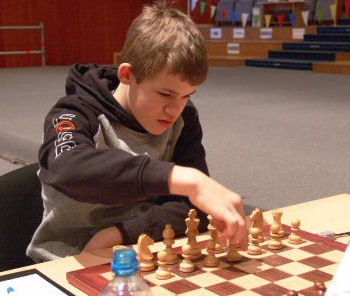
Norwegian chess prodigy Magnus Carlsen
Below we have compiled a list of the youngest grandmasters in history. In the future we may be updating this list, as new GMs under 15 years of age emerge.
Youngest grandmasters in history
Player Sergey Karjakin Parimarjan Negi IND 13 3 22 2006 Magnus Carlsen Bu Xiangzhi Teimour Radjabov Ruslan Ponomaryov Wesley So Etienne Bacrot Maxime Vachier-Lagrave Peter Leko Hou Yifan Yuri Kuzubov Nguyen Ngoc Truong Son Fabiano Caruana Koneru Humpy Hikaru Nakamura Pentala Harikrishna Judit Polgar Alejandro Ramirez Bobby Fischer
Other famous chess prodigies and records
-
Paul Morphy, 1837-1884, beat Johann Löwenthal 3-0 at age 12.
-
José Raúl Capablanca, 1888-1942, learned chess at the age of four, beat his country's chess champion in a match when he was 13, and eventually became world champion (see above).
-
Samuel Reshevsky, learned the rules at the age of 4, and gave simultaneous exhibitions at the age of six (see above).
-
Arturo Pomar played in the Spanish Championship at age 10 and became a master at age 13. He drew Alekhine in Gijon in 1944 at the age of 13.
-
Boris Spassky became an International Grandmaster at 18 and went on to become world champion.
-
Bobby Fischer became US Champion at the age of 14 and a world championship candidate at 15. He went on to become world champion.
-
Henrique Mecking of Brazil learned the game at 6, gave some simultaneous displays at 9, won the Brazilian championship at 13, and South American Zonal at 14, and became an IM at 15. He won two Interzonal Tournaments in a row, at 21 and 24.
-
Anatoly Karpov became a grandmaster at 18 and went on to become world champion.
-
Garry Kasparov became a grandmaster at 17 and went on to become the youngest ever world champion (at 22).
-
Nigel Short finished joint first in the British Championship at the age of 14.
-
Viswanathan Anand became India's first International Grandmaster at 18 and went on to become the FIDE knockout world champion.
-
Michael Adams became an International Master at 15 and a grandmaster at 17.
-
Pentala Harikrishna became India's youngest grandmaster at 15.
-
Gata Kamsky had an Elo rating of 2650 at the age of 16.
-
Luke McShane won the World Under-10 Championship at the age of eight.
-
Ruslan Ponomariov became the youngest ever FIDE knockout world champion at the age of 18.
-
Alejandro Ramirez became a grandmaster at 15, a month earlier than Fischer. He is the first grandmaster ever in Central America.
-
Magnus Carlsen became the second-youngest grandmaster in history at 13, and broke Fischer's record by becoming a world championship candidate at 15 years and one month.
-
As of this writing (January 2006) Parimarjan Negi has achieved five IM norms and one GM norm. He is twelve years old.
-
Mona Khaled achieved the WIM title and two WGM norms in 2005, when she was eleven years old. At the same time she won both the Arabian and the African Girls Junior Championship in the under 20 group in 2005, although she was the youngest player in both tournments.
-
In July 2006 Parimarjan Negi of India completed his final GM norm to become the second-youngest grandmaster in the history of the game.
-
In January 2007 David Howell became the youngest grandmaster in UK history, at sixteen years and one month, breaking Luke McShane's previous record set in 2000 by six months.
-
On December 7th 2007 Wesley So of the Philippines made his final grandmaster norm at the age of 14 years, one month and 28 days to become the seventh youngest GM in history.
-
In 2008 Hou Yifan, born February 27, 1994, in Xinghua, China, became the youngest ever female in history (at the age of 14 years 6 months 2 days) to qualify for the title of grandmaster.
Saturday, September 9, 2006
CHESS PIECE: THE 1968 MERALCO OPEN
On Sunday we will observe the birthday of the second International Grandmaster from Asia, Rosendo C. Balinas, Jr., born 10th September 1941 and passed away 24th September 1998. He got his International Master title in the 1975 Melbourne Zonal Tournament, and the International Grandmaster title in 1976. Balinas was a lawyer by professional and also one of the best chess writers we have ever had.
IN the 60s and 70s Balinas had a well-followed chess column in the Graphics Magazine and later on also wrote for several newspapers. At the same time he was among the strongest Asian chess players, winning internationals in Hongkong, Singapore and Manila. Today, to mark his day of birth, let us go back in time and follow one of his great performances – this is the 1968 Meralco Open.
1968 Meralco Open
Jan 15-Feb 2, 1968
Final Standings
(W=wins, D=draws, L=losses)
W D L Total
1 Svetozar Gligoric 11 2 2 12.0/15
2 Rosendo Balinas 11 2 2 12.0/15
3 Renato Naranja 9 4 2 11.0/15
4 Ruben Rodriguez 10 2 3 11.0/15
5 Roumel Reyes 9 2 4 10.0/15
6 Julian Lobigas 7 4 4 9.0/15
7 Bela Berger 8 1 6 8.5/15
8 Edgar de Castro 6 5 4 8.5/15
9 Carlos Benitez 6 2 7 7.0/15
10 Glicerio Badilles 5 3 7 6.5/15
11 Eugenio Torre 4 4 7 6.0/15
12 Lim Kok Ann 3 5 7 5.5/15
13 Susano Aguilar 5 0 10 5.0/15
14 Samuel Estimo 5 0 10 5.0/15
15 Poul Rasmussen 1 2 12 2.0/15
16 Lee Keng Cheong 0 2 13 1.0/15
The tournament composition was made up of 11 finalists from eliminations nationwide and included 5 invitees – the favorite GM Svetozar Gligoric of Yugoslavia, at that time one of the world’s top players, IM Bela Berger of Australia, Lee Keng Cheong of Malaysia, Thai Master Poul Rasmussen and Dr. Lim Kok Ann of Singapore. The latter was in the future to become the long-time Secretary General of the World Chess Federation (FIDE) during the Presidential term of Hon. Florencio Campomanes.
In the very first round there was a sensation – GM Gligoric underestimated his opponent, tried too hard to win and was upset by Roumel Reyes.
Gligoric,Svetozar - Reyes,Romuel [D36]
Meralco Open Manila (1), 15.01.1968
1.d4 Nf6 2.c4 e6 3.Nc3 d5 4.cxd5 exd5 5.Bg5 Be7 6.e3 0–0 7.Bd3 h6 8.Bh4 Re8 9.Nf3 c6 10.Qc2 Nbd7 11.0–0 Ne4 12.Bxe4 Bxh4 13.Bh7+ Kh8 14.b4 Be7 15.b5 Bf8 16.Bd3 Bd6 17.bxc6 bxc6 18.Na4 Nf6 19.Nc5 Qe7 20.Rfc1 Ne4 21.Bxe4 dxe4 22.Nd2 Bf5 23.Rab1 Rab8 24.Rxb8 Rxb8 25.Ncb3 Rc8 26.Nc4 Bb8 27.f4 g5 28.fxg5 Qxg5 29.Qf2 Rg8 30.Ne5 Qh5 31.g3 f6 32.Nf7+ Kh7 33.Nd2 Qh3 34.Nf1 Rf8 35.Rc5 Be6 36.Nxh6 Kxh6 37.Rxc6 Kg7 38.Nd2 Bd7 39.Rc1 f5 40.Nb3 Bd6 41.Nc5 Bc8 42.Na4 Qh5 43.Nc3 Ba6 44.Nd5 Rc8 45.Rxc8 Qd1+ 46.Kg2 Bxc8 47.Nf4 Ba6 48.h3 Bb4 49.g4 Qd2 50.gxf5 Qxf2+ 51.Kxf2 Bc4 52.a4 Kf6 53.Nh5+ Kg5 54.Ng7 Bf7 55.Ne6+ Kxf5 56.Nc5 0–1
Rosendo Balinas took his chances and sprang into the lead, closely pursued by Gligoric and Berger. Bali was the defending champion and in fine form, as can be seen from his dismantling of Lim Kok Ann.
Balinas,Rosendo - Lim,Kok Ann [C05]
Meralco Open Manila (2), 16.01.1968
1.e4 e6 2.d4 d5 3.Nd2 Nf6 4.e5 Nfd7 5.f4 c5 6.c3 Nc6 7.Ndf3 cxd4!? 8.cxd4 Nb6 9.Bd3 Bd7 10.Ne2 Be7 11.0–0 h5?!
The usual treatment for Black in this line is to allow his opponent complete freedom in the kingside while he prepares to go into action on the queenside. An important part of this master plan is the advance of Black's a-pawn. Dr. Lim prefers to make a blockade of the white squares in his kingside.
12.a3 a5 13.b3 g6 14.Kh1!
The Bobby Fischer maneuver - Kh1, Rg1 and g4.
14...Kf8 15.Rg1 Kg7 16.g4! hxg4 17.Rxg4 Rh3 18.Neg1 Rh5 19.Ra2
White's plan of attack is Ra2-g2, Ng1–e2-g3 followed by f4-f5.
19...Qh8 20.Rag2 Be8 21.Ne2 Bh4?
Best is 21...Kf8. The text move is well-motivated - Black wanted to chop off the knight when it lands on g3. However he overlooks a tactical blow ...
22.f5! exf5 23.Rxh4 Rxh4 24.Bg5
Threatening the rook as well as Bf6+ winning the queen.
24...Qh5 25.Nxh4 Nxd4 26.Qg1 Nf3 27.Nxf3 Qxf3 28.Qxb6 Qxd3 29.Qf6+ Kh7 30.Bh6!
Taking the bishop allows Qh8 mate. Black resigns. 1–0
In the 6th round all three leaders lost (Balinas to Ruben Rodriguez, Gligoric to Susano Aguilar and Berger to Estimo). Estimo, as most of you know, is the current Executive Director of the National Chess Federation (NCFP). Here is his attractive win.
Estimo,Samuel - Berger,Bela [B33]
Meralco Open Manila (6), 23.01.1968
1.e4 c5 2.Nf3 Nc6 3.d4 cxd4 4.Nxd4 Nf6 5.Nc3 e5 6.Nde2 Bc5 7.Ng3 d6 8.Be2 a6 9.0–0 Be6 10.Nd5 Bxd5 11.exd5 Ne7 12.c4 h6 13.Kh1 0–0 14.Bd3 b5 15.b3 bxc4 16.bxc4 Ng6 17.Qf3 Re8 18.Ne4 Nxe4 19.Bxe4 Rb8 20.g3 Ne7 21.Qh5 Qc8 22.g4 Bd4 23.Bxh6 Bxa1 24.Bxg7 Ng6 25.Bf6 Qxc4 26.Re1 Qb4 27.Bxg6 1–0
And here Susano Aguilar at his best.
Aguilar,Susano - Gligoric,Svetozar [B48]
Meralco Open Manila (6), 23.01.1968
1.e4 c5 2.Nf3 e6 3.d4 cxd4 4.Nxd4 Nf6 5.Nc3 d6 6.Be2 Be7 7.0–0 0–0 8.Kh1 a6 9.f4 Qc7 10.Qe1 Nc6 11.Be3 Bd7 12.a3 Rac8 13.Qg3 Kh8 14.Nf3 e5 15.f5 Nb8 16.Ng5 Qd8 17.Rad1 h6 18.Qh3 Bc6 19.Bc4 Qe8 20.Bb3 Nbd7 21.Rf3 Nc5 22.Bd5 Bxd5 23.exd5 Ncd7 24.Rg3 Rg8 25.Rf1 Nf8 26.Nge4 N8h7 27.Nd2 Rxc3 28.bxc3 Nxd5 29.c4 Ndf6 30.Bg1 Qc6 31.Rb3 b5 32.Qd3 d5 33.cxb5 axb5 34.Rxb5 Rc8 35.a4 Ng5 36.a5 e4 37.Qb3 Nd7 38.Qxd5 Qxd5 39.Rxd5 Nb8 40.c4 Bb4 41.Be3 Bxd2 42.Bxd2 Nh7 43.Bc3 Na6 44.Rfd1 1–0
This 6th round massacre allowed NM Roumel Reyes to get within striking distance and even grab the lead in the 8th round, but he was knocked back down the standings by Balinas in the 9th. Bali took a half point lead over Gligoric and maintained this by matching the Yugoslav win for win before he stumbled and lost to Ruben Rodriguez in round 12. Take note of the fighting spirit that pervaded in this tournament. Out of the 120 total games in the tournament there were only 20 draws, or 16% - nowadays you would be lucky if only 50% of the games ended in remis.
In the final round Gligoric had no difficulty defeating Badilles and Balinas razzle-dazzled Estimo with a killing attack out of the opening.
Estimo,Samuel - Balinas,Rosendo [C58]
Meralco Open Manila (15), 02.02.1968
1.e4 e5 2.Nf3 Nc6 3.Bc4 Nf6 4.Ng5 d5 5.exd5 Na5 6.Bb5+ c6 7.dxc6 bxc6 8.Qf3?!
The text move was quite poopular in the middle of the 19th century (!) and was reintroduced into tournament practice in the 1920s by Bogoljubow and up to the 1980s people were still using it. Nowadays, though, it does not have a good reputation. Black receives more active and dangerous play for the pawn than in the main lines with 8.Be2.
8...cxb5!?
Current theory holds that the best move for Black is 8...h6, and not the 8...Rb8 or 8...Qc7 given in your old opening books. This is already beyond the scope of our column today, but I’ll try to write something about recent developments in the Two Knights' defence soon.
9.Qxa8
Black's main responses here are 9...Nb7, 9...Bc5, or 9...Qd7. Balinas now uncorks his special preparation.
9...h6?! 10.Ne4 Nd5 11.Qb8
White is having trouble springing his queen from the corner. If 11.Qxa7 then 11...Nc6 12.Qa8 Qc7 and it is in danger of being trapped.
11...Nc6! 12.Qxb5 Ndb4! 13.Na3?
White should castle.
13...Ba6
See? Now he can't.
14.Qa4 Qd4
Threatening ...Qxe4+ followed by mate. Take note that Estimo can't support the kngiht with 15.d3 because of 15...Nxd3+, winning the queen on a4.
15.Nc3 Bc5 16.d3 Qxf2+ 17.Kd1 0–0
Caption: position after 17...0-0
This diagram is just to let you see how wretched White's position is.
18.Re1 Qxg2 19.Bd2 Bf2 20.Ne2 Bxe1 21.Bxe1 Bc8
The exciting 21...Bxd3! 22.cxd3 Nxd3 wins faster, but why quibble?
22.Bxb4 Bg4 23.Kd2 Qxe2+ 24.Kc3 Rc8 25.Nc4 Nd4
Threat is ...Bd7 and the queen is lost because its defence of c2 is needed.
26.Be7 Be6 0–1
Rosendo Balinas tied for first with one of the world’s top players, and overall the local contingent, none of whom were internationally titled, did not show themselves to be in any way inferior to the foreign players.
Just reading those old Meralco bulletins really made me proud of our chess tradition.
Reader comments/suggestions are urgently solicited. Email address is bangcpa@gmail.com
"This article first appeared in Bobby Ang's column in Businessworld (Philippines) on 08 September 2006"
Thursday, August 17, 2006


Wednesday, August 2, 2006
MATA vs Jerome SALTORIO
MERALCO Chess Workshop
Pasig City
1 e4 e5 2 Nf3 Nc6 3 Bc5 Nf6
4 d3 Be7
5 O-O O-O
6 c3 d5 7 exd5 Nxd5 8 h3 h6 9 Re1 Re8 10 Nbd2 Bc5 11 Ne4 Bb6 12 Qc2 Bf5 13 a4 a5 14 Qb3 Be6 15 Bd2 Nf6 16 NxN QxN 17 Be3 BxBc4 18 QxBc4 BxBe3 19 RxBe3 Rad8 20 Rae1 Rd7 21 d4 Rde7 22 d5 Nb8 23 Nd2 Qf5 24 Ne4 Nd7 25 d6 Nb6 26 Qb5 Rd7 27 dxc7 Nd5 28 Nd6 Qe6 ... [1-0].
Tuesday, August 1, 2006
MATA vs Julian SABULARSE
MERALCO Chess Workshop
Pasig City
1 e4 e5 2 Nf3 Nc6 3 Bc4 Nf6
MANUAL OF CHESS
4 d3 Bd6? 5 O-O O-O
6 Bg5 Bb4
CHESS FUNDAMENTALS
7 Nd2 d6 8 c3 Bc5 9 a4
9 ... Qe8??? 10 b4 Bb6 11 a5 Bxa5 12 bxB
Julian loses a piece.
Monday, July 17, 2006


Saturday, May 20, 2006


Tuesday, May 2, 2006
LAYLO IS CHAMP AGAIN
Twenty-six year old IM Darwin Laylo got himself a seat in the Philippine team to the 2006 Turin Olympiad (to start on the 20th of this month) by topping the 2006 National Chess Open Championship held in the Marketplace Shopping Mall in Mandaluyong City with a score of 10.5/13.
The attentive BW reader might recall that Darwin first became national champion two years ago which in turn qualified him for his maiden appearance as a member of our national squad to the 2004 Calvia de Mallorca Olympiad.
This year three Olympiad slots were up for grabs in this national championship. FM Oliver Dimakiling defeated IM Richard Bitoon in the last round to finish solo second with 10.0/13. There was a multiple tie for the 3rd and last seat between FM Wesley So (the 12-year old sensation), IM Petronio Roca, and National Masters John Paul Gomez, Roderick Nava, Rolando Nolte, and veteran Mirabeau Maga. A double round-robin elimination event was held after the Holy Week in Tagaytay and So, by scoring 2 wins and 3 draws, made chess history by becoming the youngest ever player to represent our country in a chess Olympiad.
The three qualifiers IM Darwin Laylo, FM Oliver Dimakiling and FM Wesley So will join the seeded GMs Mark Paragua, Eugene Torre and Joey Antonio in Turin for the Olympiad.
Today we will introduce Darwin Laylo to our readers. Oliver and Wesley will be discussed on Friday.
Darwin was born to a poor family in San Roque, Marikina. His father was a tricycle driver and there was not much to do at home until one day his uncle brought a chess set and taught him the moves. It soon became apparent that Darwin and the game were a magical match, and pretty soon he was defeating everyone in sight.
I first heard about him in 1993. GM Joey Antonio had just gotten his International Grandmaster title and was invited to play in a giant Quezon City Open. He won it all right but had to endure an upset loss to a 13-year old in an exciting game.
Laylo,Darwin - Antonio,Rogelio Jr [E39]
Quezon City op, 1993
1.d4 Nf6 2.c4 e6 3.Nc3 Bb4 4.Qc2 c5 5.dxc5 0–0 6.Nf3 Na6 7.a3 Bxc3+ 8.Qxc3 Nxc5 9.Bg5 Nce4 10.Bxf6 Nxf6 11.e3 b6 12.Be2 Bb7 13.0–0 Rc8 14.Rfd1 Qc7 15.Rac1 Rfd8 16.Nd4 Qb8 17.b4 d5 18.Qb3 dxc4 19.Bxc4 Ng4!
White wants to sacrifice a piece on e6, but Joey counters against h2.
20.g3 Ne5
A trap. 20...Qe5 might be even stronger but GM Joey was playing a kid who must might be enticed to sacrifice unsoundly with 21.Nxe6? when 21...Rxd1! wins the bishop on c4.
21.Be2 Qa8 22.Rxc8 Rxc8 23.Nxe6! Bh1?
Naturally Black cannot play 23...fxe6 24.Qxe6+ Nf7 25.Rd7 Rf8 26.Bc4, but the correct response would have been 23...Nf3+! 24.Bxf3 Bxf3 and both white's rook on d1 and knight on e6 are hanging.
24.Nf4 Be4 25.Qb2 f6 26.Qb3+ Kh8 27.Qe6 Re8 28.Qd6 Qc8 29.h4 Ba8 30.h5 h6 31.Kh2 Qb7 32.Nd5 Rc8 33.Qe7 Qc6 34.b5 Qc2 35.Nxf6! gxf6 36.Qxf6+ Kg8 37.Qxe5 Qe4 38.Qxe4 Bxe4 39.Rd4 Bf5 40.g4 1–0
Darwin finished 10th in the tournament and defeated several of our top players in the process - aside from GM Joey there was also Bong Villamayor and Luis Chiong – not bad for an unknown 13-year old.
Shortly after this brilliant performance he was recruited by NM Bong Cunanan into the San Sebastian chess team. This was one of the best moves that Bong ever made, for Laylo teamed up with Ronald Dableo to establish the San Sebastian dynasty in NCAA chess.
In 1999 Darwin won the National Junior (Under-20) Championship with a terrific score of 10.5/11, including a win over a soon-to-be-famous player:
Paragua,Mark - Laylo,Darwin [A08]
PHI-ChJr Greenhills (7), 22.05.1999
1.e4 c5 2.Nf3 e6 3.d3 Nc6 4.g3 d5 5.Nbd2 Nge7 6.Bg2 g6 7.0–0 Bg7 8.Re1 Qc7 9.exd5 exd5 10.d4 cxd4 11.Nb3 Bg4 12.Bf4 Qd7 13.Nc5 Qc8 14.Bd6 Bf6 15.Qd2 0–0 16.Qf4 Qf5 17.Nxb7 g5?! 18.Qxf5 Bxf5 19.Ne5 Bxc2 20.Nd7 Kg7 21.Nxf6?
Too much subtlety - he should have simply taken the rook with 21.Nxf8.
21...Kxf6 22.Na5 Rfd8 23.Bc5 d3
Now the tables have turned.
24.Nb3 Nf5 25.Nd2 Nfd4 26.Bf1 Re8 27.f3 Re6 28.Kf2 Rae8 29.Rxe6+ fxe6 30.b4 e5 31.Bh3 Ba4 32.Rc1 Ne2 33.Re1 Ncd4 34.Bxd4 Nxd4 35.Bf1 Bb5 36.a4 Bc4 37.b5 g4 38.Rb1 gxf3 39.Nxf3 Nxf3 40.Kxf3 e4+ 41.Ke3 Ke5 0–1
Next stop was the Asian Junior Championships to be held a few months later in Vung Tau, Vietnam. Bong Cunanan took Darwin to the Philippine Chess Society and asked for help in his training. He did not want the business-as-usual “training” prevalent in these times where you get some money from the Sports Commission for training in Baguio, and then spend your time there eating strawberries and flirting with girls.
The Chess Society through Sportsman Jerry Acuzar, Horace Templo and Rey Sarmiento managed to come up with the funding for serious training. I worked with Darwin for several days on his opening preparation and then arranged for a series of mini-matches with players of different styles using the time controls which will be in force in Vung Tau. The results were heartening as you can almost feel his confidence growing and strength increasing with every day. He even managed to beat GM Joey again:
Laylo,Darwin - Antonio,Rogelio Jr [A60]
Training Match Timog (2.2), 02.09.1999
1.d4 Nf6 2.c4 g6 3.Nc3 Bg7 4.g3 0–0 5.Bg2 d6 6.e4 c5 7.d5 e6 8.Nge2 exd5 9.cxd5 Re8 10.a4 Na6 11.0–0 Nb4 12.h3 a6 13.f4 Nd7 14.g4 c4 15.Be3 Qa5 16.g5 Nc5 17.Bd4 Nbd3 18.Bxg7 Kxg7 19.f5 Nb3 20.Ng3 Ne5?
A mistake. 20...Qb6+ followed by 21...Nxa1 wins material.
21.Nh5+! gxh5 22.Qxh5 Nxa1?
[22...Rg8! holds]
23.Qh6+ Kh8 24.g6
Black will be mated. 1–0
When the time came for the Junior tournament Darwin was in fighting shape – he started off in the first round by upsetting the heavy favorite to win, China’s Liang Chong. This is no mean feat – Liang had represented China in the 1999 World Championship and had even won their zonal championship.
Liang Chong (2415) - Laylo,Darwin [D85]
ASIA-ChJr Vung Tao (1), 12.09.1999
1.d4 Nf6 2.c4 g6 3.Nc3 d5 4.cxd5 Nxd5 5.e4 Nxc3 6.bxc3 Bg7 7.Bb5+ Bd7 8.Bxd7+ Nxd7 9.Ne2 0–0 10.0–0 c5 11.Rb1 Qc7 12.Qb3 Rab8 13.Bf4 e5 14.Bg3 Qc6 15.d5 Qd6 16.c4 a6 17.a4 f5 18.exf5 gxf5 19.f3 b6 20.Qd3 Rbe8 21.Nc3 Qh6 22.Rbe1 e4 23.fxe4 f4 24.Bf2 Ne5 25.Qd1 Rf6 26.Kh1 Rg6 27.Bg1 Qg5 28.Qc2 Ng4 29.Rf3 Bd4
The threat is ...Qh4, threatening the rook on e1 as well as ...Bxg1
30.Re2 Ne5 31.Ref2
[31.Rf1 f3 32.Rd2 Nxc4 33.Bxd4 Nxd2 is hopeless for White]
31...Nxf3 32.Rxf3 Qe5 0–1
Liang Chong was not able to recover from this loss. All throughout the tournament it was Darwin, Malaysia’s Hafizulhelmi Mas and India’s Krishnan Sasikiran (now a super GM) who fought for the lead. Even Iran’s highly-touted Ehsan Ghaem Maghami (now also a super GM) could not catch up with the scorching pace and was a non-factor.
Although Laylo lost to both his co-leaders he defeated everybody else and his do-or-die stance greatly impressed the public. At the end he became Vice Junior Champion of Asia by finishing solo second to Sasikiran.
When he came home to the Philippines Darwin had arrived, both literally and figuratively – he was already considered among the top players in the country. And that is where we have to cut this story of his early years up to the time he became an international campaigner.
A few years ago during a training session I noted to Darwin that his Black openings were not impressive, and suggested a switch to more open positions with the Scandinavian. I then handed him my “secret weapon”, a CD containing secret analyses prepared over several years on the Scandinavian including a complete repertoire against White’s possible replies. This also included every known/existing game on the Scandinavian in chess history with all games catalogued per variation. Darwin took this up quite seriously and is now probably the country’s greatest expert on the Scandinavian.
And this is where I will end the Darwin Laylo story, with his latest Scandinavian conquest in the tournament just concluded.
Milagrosa,Alex (2223) - Laylo,Darwin (2406) [B01]
2006 National Chess Open Ch Mens (4.1),
1.e4 d5 2.exd5 Nf6 3.c4 e6 4.dxe6 Bxe6 5.d4
It looks like White is doing fine, with an extra pawn and a strong center. In reality he has to be very careful in order to survive into the middlegame.
5...Bb4+ 6.Nc3 Ne4
Now Milagring realized the gravity of his situation and thought for a long time here. At the end he just decides to give up a pawn without, however, improving his prospects.
7.a3
[7.Qd3 Bf5! 8.Qf3 a) 8.Bd2? 0–0 9.Nxe4 (9.0–0–0 is refuted by 9...Nxc3 10.Qxf5 Nxd1 11.Bxb4 Qxd4) 9...Bxe4 10.Qe3 Re8 wins the queen; b) 8.a3 Bxc3+ 9.bxc3 0–0 10.Qf3 Re8 11.Be2 Qd7 12.Bb2 Nc6 13.g4 Bg6 14.0–0–0 Na5 15.Rd3 Nxc4 16.Re3 Ned2 17.Qxb7 Reb8 18.Qg2 Qb5 19.Ba1 Qb1# 0–1 Bilalic,M-Vescovi,G (2490)/ WJuCh, Medellin COL 1996; 8...Qxd4!]
7...Nxc3 8.Qd3 Qe7
Only on the 7th move, and White is already critical.
9.Be3 Ne4+ 10.axb4 Qxb4+ 11.Kd1
[11.Bd2 Qxb2 12.Rd1 Nxd2 13.Rxd2 Qa1+ 14.Rd1 Qa5+ 15.Rd2 0–0 16.Be2 Bf5! 17.Qb3 Nc6 18.Nf3 Be4 19.0–0 Bxf3 20.Ra2 Nxd4 0–1 Paaske,A (2038)-Simonsen,O (2183)/ Copenhagen 2000]
11...Qxb2 12.Qa3 Qxa3?
Black overlooks 12...Nxf2+
] 13.Rxa3 c6 14.Nf3 Nd7 15.Kc2 0–0 16.Bd3 Nd6 17.Nd2 Rfc8 18.Bf4 Nf5 19.Nf3 Nf6 20.h3 Rd8 21.Kc3 b5! 22.Bg5 bxc4 23.Bxf6³ gxf6 24.Bxf5 Bxf5 25.Ra5 Rd5 26.Rha1 Re8 27.Rxa7 Kg7 28.Re1 Rxe1
White has to be careful here otherwise he will be mated.
29.Nxe1 Rb5 30.Ra1 Be6 31.Ra3 Rb1 32.Kd2 Rb2+ 33.Nc2 Bf5 34.Rc3 Bd3 35.Kc1 Rb8 36.Na3 Rb4 37.Nc2 Ra4 38.Ne1 Ra1+ 39.Kd2 Ra2+ 40.Nc2 f5 41.Kc1 f4 42.Kb1?
The pressure was too much - White crumbles.
42...Rxc2 43.Rxc2 Kf6 44.Kb2 Bxc2 45.Kxc2 Ke6 0–1
Reader comments/suggestions are urgently solicited. Email address is bobby@cpamd.net
"This article first appeared in Bobby Ang's column in Businessworld (Philippines) on 01 May 2006"
Saturday, April 22, 2006
MERALCO vs TRANSCO
W: EDIZER AQUINO, TRANSCO
B: RICKY TAN, MERALCO
[0-1]
The opening used is the FRENCH DEFENSE. It was named for the players of pris led by La Bourdonnnais who adopted the move 1... e6 in 1834.
Lasker in Manual of Chess
A very logical move, developing, and at the same time preparatory to 2... d5 which engages the White K pawn and forces White to a far-reaching decision.
Kasparov and Keene in Batsford Chess Openings
It is a defense in the truest sense of the word, appealing to players who are content to endure cramped or passive positions in the hope of emerging with a superior pawn structure or an eventual counter-attack.
It's first Finals appearance was in the Steinitz vs Lasker World Championship Match in 1894 that was won by the latter.