[Bobby Ang]
Battle of the GMs
25 April-3 May 2008
Citystate Tower Hotel
Final Standings
1 GM Wesley So 2540, 8.5/11
2-3 GM Eugene Torre 2519, IM Richard Bitoon 2420, 7.5/11
4 IM John Paul Gomez 2464,7.0/11
5 GM Rogelio Antonio Jr 2529, 6.5/11
6 NM Rolando Nolte 2420, 5.5/11
7 IM Julio Catalino Sadorra 2455, 5.0/11
8-9 FM Fernie Donguines 2362, NM Oliver Barbosa 2403, 4.5/11
10-11 NM Hamed Nouri 2392, GM Buenaventura Villamayor 2425, 3.5/11
12 IM Jayson Gonzales 2468, 2.5/11
I have been receiving a lot of email lately about the composition of the Philippine team to the 2008 Dresden Olympiad. Let me share with you this one from someone who calls himself Chris Gambit (by the way, for the benefit of the other BW readers, I usually delete without reading anonymous email. I make an exception here because Chris has been a long-time contributor):
“Greetings! GM So’s victory in Dubai is certainly the biggest news in Philippine chess for a long long time. His triumph is a portent of the good things yet to come from this whiz kid. I remember playing in a rapid tournament where Wesley (who was then a chubby 10 year old) was a guest player. He won all his games, but being a guest, he did not take home the first prize.
“When my games were finished, I would look at what was happening in Wesley's board, and he always had an overwhelming position. i thought ‘wow,this boy's really good!’. I've read about chess prodigies (Capablanca, Reshevsky, Fischer, Short, Carlsen), but seeing one playing in the flesh (Wesley So), is an awesome experience! I hope that the chess gods here in our country will let Wesley play top board in the upcoming olympiad. With all due respect to GMs Torre and Antonio, I believe Wesley is the strongest Filipino player right now. After all, the olympics is the chance for the competing countries to showcase the gains of their respective chess associations, and wesley has been the best that RP chess has to offer. Thanks and good day!”
I’d like to comment that being the best player is not the only criteria for playing on top board of a team. There is this equally important thing called “maturity”. When playing on a lower board sometimes you meet up with strong players (board 3 for Russia, for example, could quite possibly be Alexander Morozevich) and sometimes weak players. But most countries nowadays have at least one strong grandmaster, and if you are board 1 that is the guy who you will be facing. It is no joke to face the likes to Vladimir Kramnik, Viswanathan Anand, Vassily Ivanchuk, Boris Gelfand, etc in consecutive rounds, and you don’t get any relief. You could take a day off, maybe, but upon walking into the tournament hall the next day there would be another strong GM trying to wipe you off the board.
When it comes to “maturity” the name which comes into everyone’s lips is that of Eugene Torre. The usual strategy for a country like the Philippines with a deep bench but no 2600s is to hold on top board and hope that the lower boards deliver the points. Believe me, mere respect alone for the giant accomplishments of Eugene will cause many players to go for a draw. These same players would go for a win if they are looking at a 14-year old sitting down to play against them.
During the 2000 Istanbul Olympiad we were scheduled to play against Spain in the afternoon. Torre wanted to take a break and GM Joey agreed to play top board for that day. After breakfast, Eugene went out for a stroll and bumped into Alexei Shirov, who approached him and offered a draw. Eugene said sorry but he was not playing that day. Well, that afternoon the Latvian-turned-Spaniard Shirov blew away GM Joey on board 1.
Here is another email, this time from Jose Alexis Marquez, who when he is not playing chess handles the Point-of-Sale (POS) terminals acquiring debit card transactions:
“A lot of people are pretty excited on the possible composition of the Philippine Team in the upcoming Chess Olympiad. Some of them are saying that with the latest success of GM Wesley So in the recently concluded 10th Dubai Open, he is now ready to man the 1st Board. Not to take anything away from GM wesley's superb performance, I still believe that with proper training and motivation, GM Eugene should return and man the top board.
“We should not be in a hurry to expose GM Wesley to too much pressure. He must be given enough time to develop his strength. We should not commit the same mistake when GM Paragua was given the assignment to man the top board.
“Below is for me a possible RP Team composition.
Board 1 - GM Eugene Torre
Board 2 - GM Mark Paragua
Board 3 - GM Joey Antonio
Board 4 - GM Bong Villamayor
Board 5 - GM Wesley So”
Well, may I invite our readers to email in their comments? Given that our team members are So, Torre, Bitoon, Antonio and Gomez, what board order should they be in?
Eugene played a relaxed tournament in the Battle of the GMs, content to let his fabulous technique stretch his opponent’s defensive capabilities to the maximum. If the opponent is successful, then we have a draw. If not, then Eugene wraps up another neat win. Witness:
Donguines,Fernie (2362) - Torre,Eugenio (2519) [B02]
Battle of Grandmasters CITYSTATE Hotel (2.1), 26.04.2008
1.e4 Nf6
Well, Eugene is obviously playing for a win.
2.e5 Nd5 3.Bc4
The only advantage of this move over 3.c4 or 3.d4 is that it has not been played half as much.
3...Nb6 4.Bb3 c5 5.c3 c4 6.Bc2 Nc6 7.d4?!
Fernie decides to give up a pawn to drum up attacking chances. Otherwise he would have played 7.Nf3 Qc7 8.Qe2 with chances for both sides.
7...cxd3 8.Qxd3 Nxe5 9.Qg3 d6 10.f4 Nc6 11.Nf3
Black is experiencing some difficulty in developing his kingside. He has to plan the following moves out carefully. In particular, whether he plays ...e6 or ...g6 White would be advancing f4-f5 to break-up his pawn structure.
11...g6 12.0–0 Bf5! 13.Bb3 Bg7 14.Nh4 Qd7 15.a4 Na5 16.Bd1 0–0 17.Nd2 Nd5
[17...Be6 18.f5 Bd5 (18...gxf5? 19.Nb3 wins a piece because of the threat of checkmate via Bh6) 19.Bg4 Qc6 is also possible, but anyway Eugene was determined to prevent f4-f5, so he leaves the bishop on f5]
18.Nxf5 gxf5 19.Bc2 e6 20.Nf3 Nc6 21.Qh3 Nf6 22.Kh1 Ng4 23.Qg3 d5 24.h3 Nf6 25.Qh4 Ne4 26.Ng5 Nxg5 27.fxg5 Ne5 28.Be3 Rfc8 29.Qh5 Ng6 30.Bb3 Be5 31.Rad1 Qe7 32.Rf3 a6 33.Re1 b5 34.axb5 axb5 35.Bf2 Qd6 36.Rfe3 Bg7 37.h4 b4 38.Qf3 bxc3 39.bxc3 Ra3 40.Qd1 Rxc3
caption: position after 40...Rxc3
Typical Fernie - he manages to find a way to sacrifice some material
41.Rxe6!? fxe6 42.Rxe6 Rcxb3
"Falling into the trap" with 42...Qxe6 43.Bxd5 still wins for Black after 43...Kf7.
43.Rxd6 Ra1 44.Qxa1 Bxa1 45.Rxd5 Rb1+ 46.Kh2
Eugene's execution is remorselessly accurate.
46...Be5+ 47.g3 Nxh4! 48.Rd8+
[48.Rxe5 Nf3+]
48...Kf7 49.Be3 Rb3 50.Bf4 Bxf4 51.gxf4 Kg6 52.Rd6+ Kh5 53.Rh6+ Kg4 54.Rxh7 Rb2+ 55.Kg1 Kg3 56.Kf1 Nf3 Mate to follow 0–1
Remember a few years ago I wrote a limerick on Donguines?
There was a chess master from Army,
Who knew only attack, named Fernie
His offensives run asunder
Against a good defender,
But he has fun doing it, doesn't he?
And, one of our readers, Mr. Butch Arroyo, countered:
I once played an FM Donguines
Whose kingside attack was the meanest,
When the carnage was done
Donguines had won
Now, who was the GM between us?
Reader comments/suggestions are urgently solicited. Email address is bangcpa@gmail.com
"This article first appeared in Bobby Ang's column in Businessworld (Philippines) on 12 May 2008"
Tuesday, May 13, 2008


Monday, May 12, 2008
CHESSDOM: KID; IVANCHUK - CHEPARINOV
Ivanchuk, V. - Cheparinov, I.
Mtel Masters 2008
Sofia Round 4
by GM Dimitrov
Hi, everybody. Welcome to the Live Coverage of Mtel Masters Super Tournament. Today we'll follow the game between Vassily Ivanchuk and Ivan Cheparinov. The Ukrainian is leading with the remarkable 3/3 and White pieces are in his hands again.
1.d4 Nf6 2.c4 g6 3.Nc3 Bg7 4.e4 d6 5.Nf3 O-O 6.Be2 e5 7.O-O Nc6 (7... Na6 is a popular alternative.)
8.d5 Ne7 The Classical King's Indian Defence. This typical main position is met for first time in the game between Tajmanov and Aronin - '1952.
9.Ne1 ( Another options are 9.Nd2 ,as Kramnik played this year against Van Wely in Nice and against Radjabov at Wijk aan Zee, and 9.b4)
9... Nd7 10.Nd3 f5 11.Bd2 Nf6 12.f3 f4 As it's known, Cheparinov has quite agressive opening repertoire. Najdorf and King's Indian with Black... no Petroff Defence in example.
13.c5 g5 14.Rc1 Ng6 15.cd6 cd6 16.Nb5 Rf7 17.Qc2 Ne8 18.Nf2 h5 19.a4( The last game on a high level in this position was won by Radjabov in his game agains the Croatian Zdenko Kozul 5 years ago. It continued: 19.a4 Bd7 20.Qb3 Bf8 21.Rc4 a6 22.Na3 Rg7 23.a5 Nf6 24.Qb6 Qe8 25.h3 g4 26.fg4 hg4 27.hg4 Nh4 28.Rc7 Qg6 29.Be1 Rh7 30.Qb3 Ne4 31.Qd3 Ng3 32.Rb7 e4 33.Ne4 Ne4 34.Rd7 Rd7 35.Bh4 Qh7 36.Rf4 Qh4 37.Re4 Bg7 38.Bf3 Rf8 39.Nc4 Rdf7 40.Re3 Rf4 41.Re4 Rf3 42.gf3 Qg3 43.Kh1 Kf7 44.Nd6 Qd6 45.Kg2 Rh8 46.Qb3 Qh2 47.Kf1 Qh1 0-1)
19... Bf8 20.h3 Rg7 21.Qb3 Nh4 22.Rc2 g4 There are just 2 games so far with this continuation. The result is quite pleasant for Black - 1,5 points out of 2.
23.fg4 Nf6 24.Be1 ( This is probably one of the key moments in this game, since Black could force exchanges on g4 with or without the profilactic move 24.Be1 Kh8)
24... hg4 25.hg4 Nh5! (25... Nh5 26.Nd1 (26.gh5? Ng2 -+ leads to disaster for White.) seems the strongest answer to this piece sacrifice according to the engines.Although after 26... Bg4 27.Bg4 Rg4 threatening Qg5, f3, Black has enough counterplay.)
26.Nh1 (26.Nh1 Bg4 27.Bg4 Rg4 28.Qh3 Qg5 29.Bh4 Qh4 30.Qh4 Rh4 31.Rfc1 Rg4 32.Kf2 a6 33.Nc7 Rb8 34.Ne6 Be7 35.Rc8 Rc8 36.Rc8 Kf7 37.Rb8 Rh4 38.Kg1 Rg4 39.Rb7 (39.Kf2 Rh4 =) 39... f3 40.g3 Nf6 41.Kf2 Ne4 42.Kf3 Nf6 43.Nd8 Ke8 44.Nc6 Bf8 45.Rb6 e4 46.Ke2 Nd5 47.Ra6 e3 = and a drawish endgame could arise.)
26... f3 optimistic move
27.Bf3 (27.gf3 Nf4 is also possible with attacking chances for Black.)
27... Nf4 28.Ng3 ( a solid move it seems. The Rybka's alternative: 28.Bh4 Qh4 29.g3 Nh3 30.Kg2 Nf4 31.Kf2 Nh3 32.Ke2 promises a big advantage, but it's not for everybody to play such positions. And mainly, it seems it's not the taste of Ivanchuk today.)
28... Bg4 29.Bg4 Rg4 30.Nc7 Rc8 31.Ne6 Rc2 (31... Rc2 32.Nd8?? is not possible, of course, because of 32... Rg2 33.Kh1 Nf3 and mate in two moves.)
32.Qc2 Qb6?! (32... Qe8 was more solid. In example: 33.Qc3 Nhg2 34.Qf3 Qg6 35.Nf8 Ne1 36.Ng6 Nf3 37.Rf3 Rg6 =)
33.Kh1 (33.Bf2 was worse than the move in the game. After 33... Nf3 34.gf3 Rg3 35.Kh1 Rh3 = the perpetual check could not be avoided.)
33... Nhg2 34.Nf5 The position must be already winning for White. Ivanchuk has 6 minutes left for 6 moves, but remember that even 6 seconds were enough for him some days ago against Topalov. The 32-nd move Qb6 for Black proved to be weak, as it forced the game to this.
34... Qa6 35.Rg1 Qd3 36.Qd3 Nd3 37.Bh4 +-
37... Re4 38.Rg2 Kf7 39.Nd6 Bd6 40.Ng5 The game is over at the move 40-rd. Ivanchuk is still leading with 4/4... Will anybody stop him at all?!
1-0
Saturday, May 10, 2008
CHESSDOM: IVANCHUK WINS MTEL MASTERS
Topalov, Veselin - Ivanchuk, Vassily
Mtel Masters 2008
Round 2
Sofia
by GM Dimitrov
After the uncompromising fight witnessed in the 1st round (not a single draw!) today we'll follow the encounter of two of the provisional leaders. Topalov unlike other years started victorious and defeated the other great favorite Aronian as Black. An important accomplishment, having in mind that he lost in their previous 3 games having the same colors. Ivanchuk on his part did a fine job against Radjabov who, nevertheless being a bit tired an out of form lately, is still a formidable opponent. Both Vassily and Veselin like to play creatively and their games attract a lot of audience. That and the shortened time control (1.30h for 40 moves + 1h till end each) make me to expect a good show. Having in mind the vast repertoire of the Ukrainian it is hard to predict the opening in such game. It is even hard to tell would Topalov open with 1.e4 or 1.d4. The sure thing is that we are to witness another intriguing chess battle.
1.e4 e6 2.d4 d5 3.Nc3 Considered to be most ambitious. (3.Nd2) has its supporters as well while the other options are harmless at best.
3... Nf6 (3... Bb4) is the Winawer variation leading to extremely complicated positions. The Ukrainian prefers a more academic approach.
4.e5 Nfd7 5.f4 c5 6.Nf3 Nc6 7.Be3 a6 Ivanchuk used this line of French Defense on several occasions. This opening was neglected for some time but gains in popularity thanks to the efforts of young Russian players such as Morozievich.
8.a3 Avoiding the mainstream (8.Qd2) Topalov seems to have managed to surprise his opponent as Black is considering his answer for almost 15 minutes.
8... cxd4 9.Nxd4 Bc5 Beginning of a typical fight for control over the 'd4' square. 7...cxd4 8.Nxd4 Bc5 leads to similar position without a3&a6 included. Ivanchuk's change of plan makes sense as this difference seems to be in his favor.
10.Be2 With a2-a3 played, the usual plan involving Qd2, O-O-O and h4 is a bit too slow. (10.Nce2 intending to strengthen control over 'd4' leaves Black to much freedom and he may go even for 10... g5) Now Black has to decide should he contest the 'd4' square after 10...Qb6 11.Na4 Qa5+ or prepare the f7-f6 breakthrough castling kingside.
10... O-O 11.Qd2 Qc7 (11... Ndxe5 12.Nxc6 Bxe3 13.Nxd8 Bxd2+ 14.Kxd2 Ng6 15.Nxf7 Rxf7 16.g3 leaves White with some advantage.)
12.Bf3 Keeping both options to castle available.
12... Nxd4 13.Bxd4 Nb6 A natural plan. Bd7 and Rc8 are to follow and the position seems to be of dynamic equality.
14.Ne2 Perhaps this is the right moment for f7-f6. (14.Ne2 f6 15.exf6 (15.Qc3 Na4) 15... Nc4 16.Qc3 Bxd4 17.Nxd4 Qxf4 18.fxg7 Qe5+) (14.Ne2 Bd7 is of course playable as well. Meanwhile Ivanchuk is consuming a lot of time.)
14... Bxd4 15.Qxd4 (15.Nxd4 f6 lets Black create direct threats.)
15... Bd7 Going for the safest approach - mobilization of all pieces keeping f6 in reserve.
16.b3 Veselin didn't get opening advantage but there is a large gap on the clock - 0.55 - 0.30.
16... Bb5 Intending never to let a Knight block the 'd5' pawn.
17.Nc3 (17.Qc3 Qxc3+ 18.Nxc3 Rfc8 19.Kd2 Rc5 20.Rac1 Rac8 is easy to play even in time trouble so Topalov keeps the Queens.)
17... Rfc8 18.Nxb5 axb5 Next step in Ivancuk's plan could be improving the position of his Knight. Even weird routes like Nb6-d7-b8-c6-e7 come to mind.
19.Be2 Nd7 ( b5 is protected tactically - 19... Nd7 20.Bxb5 Qa5+)
20.Ra2 Sad necessity. With fine positional play Vassily came to advantage but now the clock readings will be very important as well - 0.30 0.13
20... Nb8 21.O-O Nc6 Veselin finally took his King away from the center but will face difficulties defending the dark squares.
22.Qd2 (22.Qc5 Qa5 23.Qxb5 Qxb5 24.Bxb5 Nb4 25.Rb2 Rxa3 is far from attractive.)
22... Qb6+ Driving the King further away in view of eventual endings.
23.Kh1 Qa5 The foreseen time trouble approaches: 0.09 0.08
24.Qxa5 Rxa5 25.Raa1 Defending from Nc6-b4 but Nc6-d4 wins a pawn. (25.Raa1 Nd4 26.Bd3 Rca8)
25... Rca8 Time: 0.07 0.04
26.Rad1 Rxa3 27.Bxb5 Nb4 28.c4 R8a5 0.05 0.02
29.f5 exf5 30.g4 Rxb3 31.gxf5 Re3 32.Rb1 Nd3 33.e6 d4 34.Be8 Nc5 35.Bxf7+ Kf8 36.f6 gxf6 37.Rxf6 Ke7 The last 10 moves were played in blitz tempo.The arbiter was recording in the frantic scramble. They've made it to the time control, the exact moves are still awaited.
38.Rh6 d3 39.Rxh7 d2 40.Rg1 ( Decisive error. 40.Kg2 was to be preferred.)
40... Re1 41.Bh5+ Kxe6 42.Rhg7 White is completely lost. After 42...Ne4 or 42...Nd3 no chances to save the game are to be found.
42... Ne4 43.R7g6+ Ke5 White resigned. A good game by Ivanchuk. He outplayed his opponent then in the mutual time trouble commited some errors but nevertheless managed to win after Topalov blundered on move 40.
0-1
CHESS PIECE: WESLEY IS TOP GM
[Bobby Ang]
Battle of the GMs
25 April-3 May 2008
Citystate Tower Hotel
Final Standings
1 GM Wesley So 2540, 8.5/11
2-3 GM Eugene Torre 2519, IM Richard Bitoon 2420, 7.5/11
4 IM John Paul Gomez 2464,7.0/11
5 GM Rogelio Antonio Jr 2529, 6.5/11
6 NM Rolando Nolte 2420, 5.5/11
7 IM Julio Catalino Sadorra 2455, 5.0/11
8-9 FM Fernie Donguines 2362, NM Oliver Barbosa 2403, 4.5/11
10-11 NM Hamed Nouri 2392, GM Buenaventura Villamayor 2425, 3.5/11
12 IM Jayson Gonzales 2468, 2.5/11
caption: GM Wesley So
GM Wesley So has just confirmed what the ratings table suggest – that he is the top player of the Philippines. He emerged unscathed after 11 grueling rounds and topped the field by scoring 6 wins and 5 draws for 8.5/11. Living legend Eugene Torre, the only other undefeated player, finished a point behind, tied for 2nd-3rd places with Richard Bitoon at 7.5/11.
With the end of publication of Manny Benitez’ “The Chess Plaza Weekender” and its hard-hitting commentary “From my Swivel Chair” I thought to take up the slack and bit and do a bit of commentary myself. So here they are:
1. There is, of course, no such animal as a super-grandmaster, as Hon. Florencio Campomanes loves to say. The truth is that the only international titles for over-the-board play (men) are Candidate Master (abbreviated as CM, for those players with ratings of at least 2200), FIDE Master (FM, rating of at least 2300), International Master (IM, rating of at least 2400), and International Grandmaster (GM rating of at least 2500). A super-Grandmaster is simply an adjective to denote a grandmaster who is really very strong and regularly beats other grandmasters. Usually the demarcation line for this is the attainment of a FIDE rating in excess of 2600 pts.
2. The reason I bring up this thing about the super-GM is because some ignorant reporters (take note that I make a point not to call them journalists) have written that Wesley’s next goal is to attain the title of super-grandmaster, and that he already scored one super-GM norm by winning the Dubai Open.
3. Well, of course that thing about attaining the super-GM title and the norm is just plain stupid, but on the other hand it is true that Wesley’s next goal is to bring his rating up to 2600. How is he doing in this regard? Well, he gained 18.7 points by winning in Dubai, and a further 11.8 points with his victory in his 6-game match with Indonesian Champion Susanto Megaranto. This latest Battle of the GMs triumph is an additional 15.7 pts. Add all of this up to his current rating of 2540 and we come up with a new rating of 2586.
4. Wesley still has two big tournaments coming up this month. The 2nd Philippine Open International Tournament is scheduled May 6-15 at the La Legenda Hotel in Subic Bay Freeport followed immediately by the 3rd Philippine Open from May 15-24 in Pampanga. Both tournaments are 11-round Swiss system events. Hopefully, Wesley So can keep up his strength, sustain the fine form, and bring home the bacon.
5. It was announced that the result of this tournament will determine the Philippine team to the Dresden Chess Olympiad which will start November 12. If that information is correct then our representatives will consist of GM Wesley So, GM Eugene Torre, IM Richard Bitoon, IM John Paul Gomez and GM Rogelio Antonio Jr. (starting Dresden, each team will have 5 players instead of the 6 of previous Olympiads). My assessment of this squad is that it is quite strong and should do well in Dresden.
6. Hopefully, they get a real team captain to whip them into shape and lead the Filipino charge, and then my confidence level is high that they can land in the top 20. Please, no more junkets for politicians or hangers-on. A team captain is not a ceremonial position. The team captain has to attend to the accommodations of the players, see to it that they are psyched and ready for battle during the games. He also has to look around the tournament hall at the potential opponents and keep track of who is hot and who is not. Also, he has to go over the tournament bulletins and take note of the openings that are being played and the latest theoretical trends. A very important role which is completely overlooked in many cases.
7. GM Mark Paragua did not take part because he had gone to the States to campaign. I am not sure whether Cong. Pichay intends to bring him home to beef up the team. We will postpone discussion of this nagging question for another column.
8. I was wondering about the participation of Fernie Donguines in this tournament. If you do a bit of research, it becomes obvious that he has no business participating. It is true that Fernie has one GM norm, but he got that way back in 1994 – 14 years ago! Donguines is currently rated no. 42 in the country. Some of the players who were bypassed are GM Darwin Laylo, IM Ronald Dableo (2 GM norms), and IM Oliver Dimakiling (2 GM norms). Who can explain this to us?
9. I wish that the chess reporters would stop calling Jayson Gonzales an International Grandmaster, he isn’t one. True, he has obtained the three GM norms required, but he still has to attain a minimum rating of 2500 to get the title. This is not an easy requirement, and there are a heck of a lot of players who never reach this milestone.
10. Jayson’s current rating is 2468 and he just lost 33 rating points by finishing last in the “Battle of GMs” – points that he has to make up for. Outstanding players like Wesley get 18.7 pts in one tournament, but he had to win the Dubai Open to do that. Jayson has never gotten close to such a performance. For most players a good result in an international tournament will get you an additional 10 rating pts. Equating that with IM Jayson Gonzales’ soon-to-be rating of 2435, that means he has to get good results in 6-7 tournaments, without the ratings catastrophe similar to what he experienced in the Battle of GMs. I am afraid it will take another 2 years before he gets the grandmaster title.
Here is Wesley’s win in the 9th round over Richard Bitoon to virtually guarantee himself the top prize of P200,000.
So,Wesley (2540) - Bitoon,Richard (2420) [B99]
Battle of Grandmasters CITYSTATE Hotel (9.5), 01.05.2008
1.e4 c5 2.Nf3 d6 3.d4 cxd4 4.Nxd4 Nf6 5.Nc3 a6 6.Bg5 e6 7.f4 h6 8.Bh4 Nbd7 9.Qf3 Be7 10.0–0–0 Qc7 11.Bd3 g5 12.fxg5 Ne5
The same line as So vs Adly from the Dubai Open, which we annotated here a week or so ago.
13.Qe2 Nfg4 14.Nf3 Nxf3
[14...hxg5 is the move with the best theoretical reputation]
15.Qxf3 Ne5 16.Qh5 Ng6 17.Bg3 hxg5 18.Qf3 Bd7
Adly played 18...Ne5 19.Bxe5 dxe5 20.Rdf1 Rh7 21.h4 gxh4 22.Qg4 Rh6 (So,W (2540)-Adly,A (2578) /Dubai 2008 1–0 37), but on looking at this position again I realize that Wesley had an easier win with 23.Qg8+ Kd7 24.Rxf7 White has too many threats, not the least of which is 25.Bb5+! axb5 26.Rxe7+ Kxe7 27.Qg7+ Kd8 28.Rd1+ Bd7 29.Qf8#.
19.Rhf1 Rf8 20.Qe3 0–0–0 21.Qa7 Ne5 22.Be2 Nc6 23.Qa8+ Nb8
[23...Qb8 24.Qxb8+ Kxb8 25.Rxd6 wins a pawn]
24.a4 Bc6 25.Qa7 Nd7 26.Qa8+ Nb8 27.Qa7 Nd7 28.Bh5 Nf6?
caption: position after 28...Nf6
29.Rxf6! Bxf6 30.Rxd6! Rxd6 31.Qa8+ Kd7 32.Qxf8 Be7 33.Qxf7 Qd8 34.Bxd6 Kxd6 35.Bg4 Bd7 36.e5+ Kxe5 37.Qf2 Qf8 38.Qe3+ Kd6 39.Qd4+ Kc7 40.Qc4+ Kd8 41.Bf3
[41.Bxe6? Bxe6 42.Qxe6 Qf1+ 43.Kd2 Qxg2+ considerably complicates White's task]
41...Bc8 42.Kb1 Bd6 43.Ne4 Be7
[43...Bxh2 44.Nxg5]
44.Qd4+ Kc7 45.Qe5+ Kb6
[45...Bd6 46.Qc3+ Kb8 47.h3 holds out longer]
46.Nxg5 Qf5 47.a5+ Ka7 48.Qc7 Qc5 49.Qxc5+ Bxc5 50.Bg4 Be3 51.Bxe6 Bxg5 52.Bxc8 Bd2 53.c3 Bf4 54.h4 Bc7 55.b4 b6 56.axb6+ Kxb6 57.Kc2 a5 58.bxa5+ Kxa5 59.Kd3 Kb5 60.h5 Be5 61.g4 Kc5 62.c4 Kd6 63.Ke4 Bf6 64.Kf5 Bd4 65.g5 Ke7 66.Kg6 Be3 67.h6 Bf4 68.c5 1–0
Reader comments/suggestions are urgently solicited. Email address is bangcpa@gmail.com
"This article first appeared in Bobby Ang's column in Businessworld (Philippines) on 09 May 2008"
Battle of the GMs
25 April-3 May 2008
Citystate Tower Hotel
Final Standings
1 GM Wesley So 2540, 8.5/11
2-3 GM Eugene Torre 2519, IM Richard Bitoon 2420, 7.5/11
4 IM John Paul Gomez 2464,7.0/11
5 GM Rogelio Antonio Jr 2529, 6.5/11
6 NM Rolando Nolte 2420, 5.5/11
7 IM Julio Catalino Sadorra 2455, 5.0/11
8-9 FM Fernie Donguines 2362, NM Oliver Barbosa 2403, 4.5/11
10-11 NM Hamed Nouri 2392, GM Buenaventura Villamayor 2425, 3.5/11
12 IM Jayson Gonzales 2468, 2.5/11
caption: GM Wesley So
GM Wesley So has just confirmed what the ratings table suggest – that he is the top player of the Philippines. He emerged unscathed after 11 grueling rounds and topped the field by scoring 6 wins and 5 draws for 8.5/11. Living legend Eugene Torre, the only other undefeated player, finished a point behind, tied for 2nd-3rd places with Richard Bitoon at 7.5/11.
With the end of publication of Manny Benitez’ “The Chess Plaza Weekender” and its hard-hitting commentary “From my Swivel Chair” I thought to take up the slack and bit and do a bit of commentary myself. So here they are:
1. There is, of course, no such animal as a super-grandmaster, as Hon. Florencio Campomanes loves to say. The truth is that the only international titles for over-the-board play (men) are Candidate Master (abbreviated as CM, for those players with ratings of at least 2200), FIDE Master (FM, rating of at least 2300), International Master (IM, rating of at least 2400), and International Grandmaster (GM rating of at least 2500). A super-Grandmaster is simply an adjective to denote a grandmaster who is really very strong and regularly beats other grandmasters. Usually the demarcation line for this is the attainment of a FIDE rating in excess of 2600 pts.
2. The reason I bring up this thing about the super-GM is because some ignorant reporters (take note that I make a point not to call them journalists) have written that Wesley’s next goal is to attain the title of super-grandmaster, and that he already scored one super-GM norm by winning the Dubai Open.
3. Well, of course that thing about attaining the super-GM title and the norm is just plain stupid, but on the other hand it is true that Wesley’s next goal is to bring his rating up to 2600. How is he doing in this regard? Well, he gained 18.7 points by winning in Dubai, and a further 11.8 points with his victory in his 6-game match with Indonesian Champion Susanto Megaranto. This latest Battle of the GMs triumph is an additional 15.7 pts. Add all of this up to his current rating of 2540 and we come up with a new rating of 2586.
4. Wesley still has two big tournaments coming up this month. The 2nd Philippine Open International Tournament is scheduled May 6-15 at the La Legenda Hotel in Subic Bay Freeport followed immediately by the 3rd Philippine Open from May 15-24 in Pampanga. Both tournaments are 11-round Swiss system events. Hopefully, Wesley So can keep up his strength, sustain the fine form, and bring home the bacon.
5. It was announced that the result of this tournament will determine the Philippine team to the Dresden Chess Olympiad which will start November 12. If that information is correct then our representatives will consist of GM Wesley So, GM Eugene Torre, IM Richard Bitoon, IM John Paul Gomez and GM Rogelio Antonio Jr. (starting Dresden, each team will have 5 players instead of the 6 of previous Olympiads). My assessment of this squad is that it is quite strong and should do well in Dresden.
6. Hopefully, they get a real team captain to whip them into shape and lead the Filipino charge, and then my confidence level is high that they can land in the top 20. Please, no more junkets for politicians or hangers-on. A team captain is not a ceremonial position. The team captain has to attend to the accommodations of the players, see to it that they are psyched and ready for battle during the games. He also has to look around the tournament hall at the potential opponents and keep track of who is hot and who is not. Also, he has to go over the tournament bulletins and take note of the openings that are being played and the latest theoretical trends. A very important role which is completely overlooked in many cases.
7. GM Mark Paragua did not take part because he had gone to the States to campaign. I am not sure whether Cong. Pichay intends to bring him home to beef up the team. We will postpone discussion of this nagging question for another column.
8. I was wondering about the participation of Fernie Donguines in this tournament. If you do a bit of research, it becomes obvious that he has no business participating. It is true that Fernie has one GM norm, but he got that way back in 1994 – 14 years ago! Donguines is currently rated no. 42 in the country. Some of the players who were bypassed are GM Darwin Laylo, IM Ronald Dableo (2 GM norms), and IM Oliver Dimakiling (2 GM norms). Who can explain this to us?
9. I wish that the chess reporters would stop calling Jayson Gonzales an International Grandmaster, he isn’t one. True, he has obtained the three GM norms required, but he still has to attain a minimum rating of 2500 to get the title. This is not an easy requirement, and there are a heck of a lot of players who never reach this milestone.
10. Jayson’s current rating is 2468 and he just lost 33 rating points by finishing last in the “Battle of GMs” – points that he has to make up for. Outstanding players like Wesley get 18.7 pts in one tournament, but he had to win the Dubai Open to do that. Jayson has never gotten close to such a performance. For most players a good result in an international tournament will get you an additional 10 rating pts. Equating that with IM Jayson Gonzales’ soon-to-be rating of 2435, that means he has to get good results in 6-7 tournaments, without the ratings catastrophe similar to what he experienced in the Battle of GMs. I am afraid it will take another 2 years before he gets the grandmaster title.
Here is Wesley’s win in the 9th round over Richard Bitoon to virtually guarantee himself the top prize of P200,000.
So,Wesley (2540) - Bitoon,Richard (2420) [B99]
Battle of Grandmasters CITYSTATE Hotel (9.5), 01.05.2008
1.e4 c5 2.Nf3 d6 3.d4 cxd4 4.Nxd4 Nf6 5.Nc3 a6 6.Bg5 e6 7.f4 h6 8.Bh4 Nbd7 9.Qf3 Be7 10.0–0–0 Qc7 11.Bd3 g5 12.fxg5 Ne5
The same line as So vs Adly from the Dubai Open, which we annotated here a week or so ago.
13.Qe2 Nfg4 14.Nf3 Nxf3
[14...hxg5 is the move with the best theoretical reputation]
15.Qxf3 Ne5 16.Qh5 Ng6 17.Bg3 hxg5 18.Qf3 Bd7
Adly played 18...Ne5 19.Bxe5 dxe5 20.Rdf1 Rh7 21.h4 gxh4 22.Qg4 Rh6 (So,W (2540)-Adly,A (2578) /Dubai 2008 1–0 37), but on looking at this position again I realize that Wesley had an easier win with 23.Qg8+ Kd7 24.Rxf7 White has too many threats, not the least of which is 25.Bb5+! axb5 26.Rxe7+ Kxe7 27.Qg7+ Kd8 28.Rd1+ Bd7 29.Qf8#.
19.Rhf1 Rf8 20.Qe3 0–0–0 21.Qa7 Ne5 22.Be2 Nc6 23.Qa8+ Nb8
[23...Qb8 24.Qxb8+ Kxb8 25.Rxd6 wins a pawn]
24.a4 Bc6 25.Qa7 Nd7 26.Qa8+ Nb8 27.Qa7 Nd7 28.Bh5 Nf6?
caption: position after 28...Nf6
29.Rxf6! Bxf6 30.Rxd6! Rxd6 31.Qa8+ Kd7 32.Qxf8 Be7 33.Qxf7 Qd8 34.Bxd6 Kxd6 35.Bg4 Bd7 36.e5+ Kxe5 37.Qf2 Qf8 38.Qe3+ Kd6 39.Qd4+ Kc7 40.Qc4+ Kd8 41.Bf3
[41.Bxe6? Bxe6 42.Qxe6 Qf1+ 43.Kd2 Qxg2+ considerably complicates White's task]
41...Bc8 42.Kb1 Bd6 43.Ne4 Be7
[43...Bxh2 44.Nxg5]
44.Qd4+ Kc7 45.Qe5+ Kb6
[45...Bd6 46.Qc3+ Kb8 47.h3 holds out longer]
46.Nxg5 Qf5 47.a5+ Ka7 48.Qc7 Qc5 49.Qxc5+ Bxc5 50.Bg4 Be3 51.Bxe6 Bxg5 52.Bxc8 Bd2 53.c3 Bf4 54.h4 Bc7 55.b4 b6 56.axb6+ Kxb6 57.Kc2 a5 58.bxa5+ Kxa5 59.Kd3 Kb5 60.h5 Be5 61.g4 Kc5 62.c4 Kd6 63.Ke4 Bf6 64.Kf5 Bd4 65.g5 Ke7 66.Kg6 Be3 67.h6 Bf4 68.c5 1–0
Reader comments/suggestions are urgently solicited. Email address is bangcpa@gmail.com
"This article first appeared in Bobby Ang's column in Businessworld (Philippines) on 09 May 2008"
Tuesday, May 6, 2008
CHESSBASE: BAKU GRAND PRIX
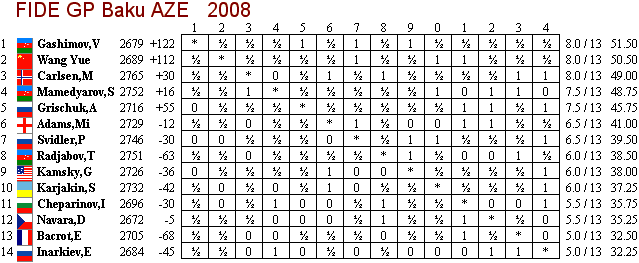
Baku R13: Gashimov, Wang and Carlsen win Grand Prix
05.05.2008 – There are three winners of the First FIDE Grand Prix in Baku: Vugar Gashimov, Wang Yue and Magnus Carlsen, all of whom ended at 8.0/13 points. The leaders Gashimov and Wang drew their games, while the incredible Magnus Carlsen scored his second win in succession (when it mattered!) to join the leading group. We bring you games, results, prizes, photos and videos.
 First FIDE Grand Prix in Baku
The first FIDE Grand Prix tournament took place in Baku, Azerbaijan, from April 20th to May 6th, 2008. There were thirteen rounds and two rest days (April 26 and May 1st). The event, organised by Global Chess, is part of a series of six tournaments to be held over two years (2008-2009). 21 top world players are selected to compete in these tournaments, with each player contracting to participate in exactly four of these tournaments. The winner of the Grand Prix series at the end of 2009 will play the winner of the World Cup held in 2009 in an eight game match to become the challenger to the World Champion in a match to be held in the third quarter of 2010.
Round thirteen report (final)
Round 13: Monday, May 5th
Gata Kamsky Ivan Cheparinov Teimour Radjabov Vugar Gashimov Magnus Carlsen Shak. Mamedyarov Ernesto Inarkiev
Please note that the games are being annotated in the Chess Media System by GM Zurab Azmaiparashvili, who is also a Vice President of FIDE. Instructions on how to view these files is given at the bottom of this page.
Video impressions of round 13
Grischuk-Radjabov was a King's Indian which was drawn in 32 moves. Karjakin-Kamsky saw White "blundering" (Karjakin's feeling) at move 20 but hanging on for a 44-move draw. Adams-Gashimov was a draw by the tournament leader, achieved with the black pices and without too many problems. Wang Yue-Mamedyarov saw the other leader, Wang, also draw his game in 47 moves. It was the last game to finish.
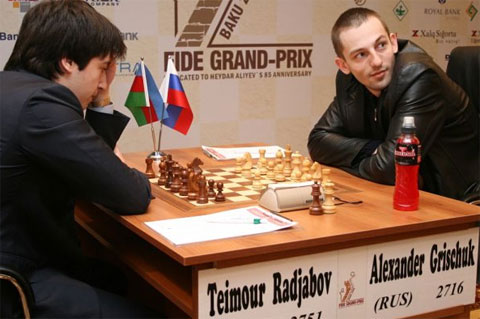
Navara-Cheparinov brought a second victory for the Czech player who defeated his Bulgarian counterpart in a Slav Defence with white.
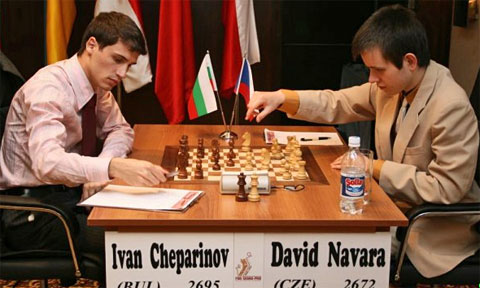
Navara,D (2672) - Cheparinov,I (2696) [D12]
FIDE GP Baku AZE (13), 05.05.2008
1.d4 d5 2.c4 c6 3.Nf3 Nf6 4.e3 Bf5 5.Nc3 e6 6.Nh4 Be4 7.f3 Bg6 8.Qb3 Qc7 9.Bd2 Be7 10.Be2 Bh5 11.0-0-0 dxc4 12.Qxc4 a6 13.g4 b5 14.Qd3 Bg6 15.Nxg6 hxg6 16.f4 c5 17.dxc5 Qxc5 18.Kb1 Nc6 19.Ne4 Qb6 20.Nxf6+ gxf6 21.h4 Rd8 22.Qc3 Bb4 23.Qxf6 Bxd2 24.h5 Qxe3 25.hxg6
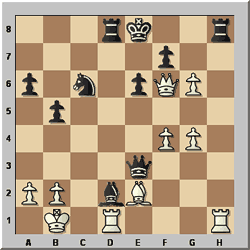
25...Qe4+?? In the press conference Navara said he had heard that the computer says Black is winning after 25...Kd7 instead of 25...Qe4+. Now he is losing. 26.Ka1 Rf8 27.gxf7+ Kd7 28.Rxd2+ Kc7 29.Rxd8 Qxh1+ 30.Rd1 Qe4 31.Bd3 Qf3 32.Rc1 Qxd3 33.Qe7+ 1-0. [Click to replay]
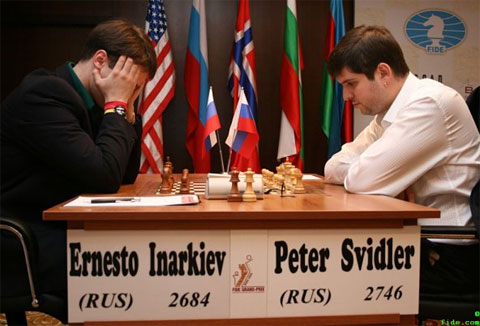
Svidler-Inarkiev was Peter Svidler's second win in a row, and took him up to a 50% score. Bacrot-Carlsen was also a second consecutive win, for the highest rated (and youngest) player in the tournament. "It was a good game by Magnus," his opponent Etienne Bacrot said.
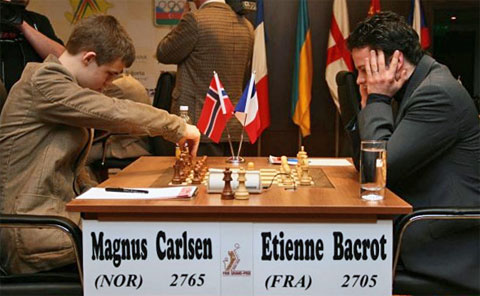
Bacrot,E (2705) - Carlsen,M (2765) [E21]
FIDE GP Baku AZE (13), 05.05.2008
1.d4 Nf6 2.c4 e6 3.Nc3 Bb4 4.Nf3 b6 5.Bg5 Bb7 6.Nd2 h6 7.Bh4 Nc6 8.a3 Bxc3 9.bxc3 Qe7 10.e3 g5 11.Bg3 d6 12.h4 0-0-0 13.Be2 Nd7 14.Nb3 f5 15.Qc2 Rhf8 16.f3 e5 17.hxg5 hxg5 18.0-0-0 Rde8 19.Bd3 Qf7 20.Rh6 Ba6 21.Nd2 exd4 22.exd4 Na5 23.Rdh1 Re7
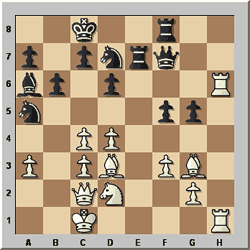
24.Qa4? Both players though this was a mistake, since it allowed 24...Re3 "with the idea to take on d3 at some point" (Carlsen). 25.Rh7 Qe8 26.Qc2 Nf6 27.R7h6 Kb7 28.Bf2 Rxd3 29.Qxd3 Nd5 30.Re1 Qa4 31.Qc2 Qxa3+ 32.Qb2 Qxb2+ 33.Kxb2 Nxc4+ 34.Nxc4 Bxc4 35.Be3 g4 36.fxg4 fxg4 37.Rg6
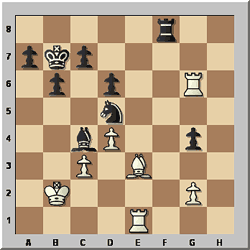
On the Playchess server Carlsen fans were looking at 37...Re8 and a forced win: 38.Bd2 Rxe1 39.Bxe1 Nf4 40.Rxg4 Nd3+ 41.Kb1 Nxe1–+. Their collective hearts stopped when Magnus played 37...a5 and the Fritz evaluation dropped from 3.00 to 0.75. They were able to quickly work out that Black would end up with an extra pawn in an opposite bishop ending, which usually spells a dead draw. But Norwegian Magni are made of sterner stuff. With precise and imaginative play the 17-year-old took the point to join the leading group in the final table of the tournament. 38.Rxg4 a4 39.Rg3 a3+ 40.Kxa3 Ra8+ 41.Kb2 Ra2+ 42.Kc1 Nxc3 43.Bd2 Ne2+ 44.Rxe2 Bxe2 45.Rg7 Ra4 46.Bc3 b5 47.g4 Bf3 48.g5 b4 49.Bb2 Ra5 50.Kc2 Bd5 51.Re7 Bc4 52.Bc1 Rf5 53.Bd2 Rf2 54.g6 Rg2 55.g7 Kc6 56.Re8 Bf7 57.Rb8 b3+ 58.Kc3 Rxg7 59.Kb2 Bc4 60.Kc3 Kd5 61.Rb7 Rg3+ 62.Kb2 Kxd4 0-1. [Click to replay]
Press conference with Etienne Bacrot and Magnus Carlsen
Final standings
Monday, May 5, 2008
2nd CASIANO SOL CRUZ, JR Memorial Cup
The Sol Cruz family sponsored the 2nd Casiano Sol Cruz Memorial Cup in commemoration of the second death anniversary of their father, a MERALCO retiree.


Sunday, May 4, 2008
CHESSBASE: BAKU's BLUNDER of the TOURNAMENT
Bacrot-Inarkiev produce the "blunder of the tournament" (Bacrot), which sadly ended the most exciting game of the round. "This is the result of the Sofia rule," Inarkiev said afterwards, "he has used all his energy and in that position he had already spent a lot of time."

The "unglücksrabe" (German: unlucky raven) Etienne Bacrot in his game against Inarkiev
Bacrot,E (2705) - Inarkiev,E (2684) [C69]
FIDE GP Baku AZE (11), 03.05.2008
1.e4 e5 2.Nf3 Nc6 3.Bb5 a6 4.Bxc6 dxc6 5.0-0 Be7 6.Nxe5 Qd4 7.Nf3 Qxe4 8.d3 Qg4 9.Nc3 Be6 10.Re1 h6 11.h3 Qh5 12.Re5 g5 13.Ne2 Qg6 14.Ned4 Bd7 15.Qe2 f6 16.Ne6 Kf7
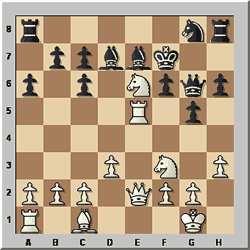
Here White missed a good opportunity, as tournament annotator Sergey Shipov and Fritz explain: 17.Nxc7! Rc8 18.Ne6 Bd6 19.Nc5 fxe5 20.Nxd7 Kg7 21.Ndxe5 Qe6 22.b3! and White keeps on attacking, having two pawns for an exchange and a great advantage in the centre (Shipov); +/– 1.11 depth 18/39 at 2,869,000 positions per second (Deep Fritz 10). But Inarkiev missed it. 17.d4 Bd6 18.Nc5 fxe5 19.Nxd7 Qf5 20.Ndxe5+ Kg7 21.Nc4 Rf8 22.Nxd6 cxd6
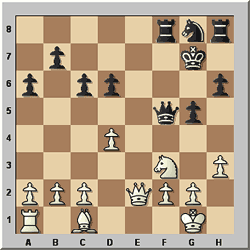
23.Qe7+?? 0-1. You figure out the refutation. Hint: a black knight is somehow involved. [Click to replay]
The whole tragic scene was caught by Peter Doggers in his video report given at the top of this page:
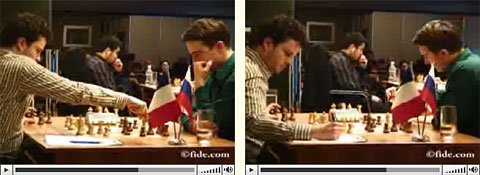
Etienne Bacrot executes the move 23.Qe7+ and both players calmly write it down
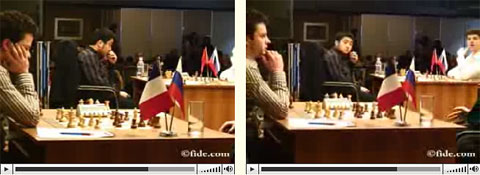
Bacrot starts to think and then suddenly realises what he has done. Wang Yue and
Peter Svidler on the adjacent table notice that something extraordinary has happened
Saturday, May 3, 2008
CHESS PIECE: SO-MEGARANTO
[Bobby Ang]
Japfa Match
Jakarta, Indonesia
April 17-20, 2008
123456
1 So,W 2540 111½0½ 4.0/6
2 Megaranto,S 2561 000½1½ 2.0/6
Have you noticed that lately it seems like all we are writing about is Wesley So? Well, that is because he is on a hot streak and has won another chess event. Wesley So defeated the reigning Indonesian Champion GM Susanto Megaranto 4-2 in their one-on-one match held during the Japfa Chess Festival 2008 being held at the Indonesian Sports Council Hall in Jakarta, Indonesia.
Indonesian chess had long been dominated by GM Utut Adianto (yes, he knows what his first name means in Pilipino). Together with a few sponsors he put up a chess school in the late 90s to prepare and train the next generation who will take over when he retires. Megaranto was schooled by no less than Adianto himself. I remember 8 years ago during the Asian Under-16 Championship held in Bataan (I organized that, remember?) Megaranto was a very small boy, only slightly taller than 4 feet, but his chess was very strong and he would grind out 60-move endgame wins without batting an eyelash. The punishing pace tired him, though, and a weak finish allowed Bacolod’s Sander Severino to come from behind to win the bragging rights as the best Under-16 player in Asia and the FIDE Master title.
Anyway, since then Susanto had made giant strides and for the first time overtook Adianto in the rating table this January.
Susanto Megaranto (born 8 October 1987), similar to Wesley, is the youngest in his country’s history to attain the title of GM. He accomplished the feat at the age of 17, beating out Adianto’s record by four years.
I expected the match to be close but the Philippines’ youngest GM won the first three games and drew the fourth to clinch the victory. The last two games were no-bearing and Megaranto managed to recover some ground by winning one and drawing the other.
In fact, Megaranto should not have won the 5th game either – perhaps lulled to complacency due to his overwhelming position, Wesley got careless and allowed his a devastating combination:
So,Wesley (2540) - Megaranto,Susanto (2561) [B00]
Japfa Match Jakarta INA (5), 19.04.2008
1.e4 Nc6 2.Nf3 d6 3.d4 Bg4 4.Nc3 e6 5.Be3 Nf6 6.h3 Bh5 7.d5 exd5 8.exd5 Bxf3 9.Qxf3 Ne5 10.Qe2 h5 11.0–0–0 Be7 12.f4 Ned7 13.g3 c5 14.Bg2 0–0 15.g4 b5 16.g5 Nh7 17.Qxh5 b4 18.Ne4 Qa5 19.Kb1 Rab8
I don't know what kind of garbage opening Megaranto is playing, but white is already winning, and only has to take care to avoid swindles. This Wesley was not able to do.
20.f5 Rfe8 21.Bf4 c4 22.Bxd6 Nhf6
Desperation. White was threatening to exchange bishops on e7 and then followup with the killer f5-f6.
23.gxf6 Nxf6 24.Qh4?
Simply 24.Nxf6+ Bxf6 25.Bxb8 Rxb8 26.Qf3 c3 27.Qf4 (27.b3?? Qa3) 27...Rb6 28.Qc7 forces resignation. I refuse to believe that Wesley didn’t see this – he probably wanted to try a more fancy way. Bummer.
24...Nxe4 25.Bxe7?
caption: position after 25.Bxe7
Remember what I said about avoiding swindles? White HAD to take the knight. Why? ...
25...Nc3+! 26.Kc1
[26.bxc3 Qa3! 27.Ka1 Qxc3+ 28.Kb1 b3 forces mate]
26...b3! 27.cxb3 cxb3 28.axb3 Qa1+ 29.Kc2 Nxd1 30.Rxd1 Rbc8+ 31.Kd2 Qxb2+ 32.Ke1 Qxg2 0–1
But let us not be too harsh on Wesley - on the whole he showed his best qualities and dominated Megaranto. Here is what I believe to be the best game from the match.
So,Wesley (2540) - Megaranto,Susanto (2561) [B19]
JAPFA Festival Match Jakarta (1), 17.04.2008
1.e4 c6 2.d4 d5 3.Nc3 dxe4 4.Nxe4 Bf5 5.Ng3 Bg6 6.h4 h6 7.Nf3 Nd7 8.h5 Bh7 9.Bd3 Bxd3 10.Qxd3 e6 11.Bf4 Qa5+ 12.Bd2 Qc7 13.0–0–0 Ngf6 14.Ne4 0–0–0 15.g3 Nxe4
[15...Nc5 16.Nxc5 Bxc5 17.c4 Bb6 18.Bc3 is slightly better for White]
16.Qxe4 Nf6 17.Qe2 Bd6
In "Opening for White according to Anand", the author former FIDE world champion Alexander Khalifman points out that 17...c5? is bad because of 18.dxc5 Bxc5 19.Rh4! and "Black is in grave danger now". Here is an example of what might happen: 19...Kb8 20.Bf4! Bd6 21.Rxd6 Rxd6 22.Ne5! White is threatening either Nxf7 or Nc4 and Black will have difficulty meeting it. Tal,M (2615)-Huebner,R (2595)/ Montreal 1979 1–0 (41).
18.c4 c5
[18...Kb8?? 19.c5]
19.Bc3 cxd4
Khalifman: This is the principled decision. Black obtains a pawn majority in the kingside and some counterplay along the opened d-file. White in his turn can try to exploit his pawn majority on the queenside.
20.Nxd4 a6 21.Kb1 Rd7 22.Rc1
GM Joey Antonio once lost a game in the Internet Chess Club after 22.Nb3 Rhd8? 23.Ba5! b6 24.c5 Bxc5 25.Rc1 Rd5 26.Nxc5 Rxc5 27.Qxa6+ and he had to resign. Crafty-Antonio,R/ ICC 1999.
22...Qc5
Perhaps this move is a mistake? White wants to play Nb3 and putting his queen on c5 provokes him to do just that. The usual move is 22...Kb8.
23.Nb3 Qf5+ 24.Rc2
Now the play revolves around White's plan to push his c-pawn to c6.
24...Bc7
So that if 25.c5 then 25...Qd3 exchanging queens.
25.Bxf6 gxf6 26.c5 Rd5?
The bulletin gives 26...Qd5 as best, I think it is 26...Qd3. Whatever it is, the text move is not it.
27.c6! b5?
Another mistake. Definitely 27...Qe5 was the only way to fight on.
28.Qe3
The queen penetrates. Wesley is already winning.
28...Kd8
[28...Kb8 29.Nc5 Rhd8 (just in case White misses the back rank check) 30.Rhc1 Black is at a loss]
29.Qa7 Re8 30.Nc5 a5 31.Na6 Qe5 32.Rhc1 Qd6 33.Qa8+ Ke7 34.Qb7 Kd8
Black is paralyzed, but how can White break through? Wesley's solution is simple but effective.
35.Rc5!
Forcing the exchange of rooks, afer which black is vulnerable on the d-file. Watch.
35...Rxc5 36.Rxc5 f5 What else can he do? 37.Rc2 Rg8 38.Nxc7 1-0
After 38...Qxc7 39.Rd2+ finishes him off.
Reader comments/suggestions are urgently solicited. Email address is bangcpa@gmail.com
"This article first appeared in Bobby Ang's column in Businessworld (Philippines) on 02 May 2008"
Japfa Match
Jakarta, Indonesia
April 17-20, 2008
123456
1 So,W 2540 111½0½ 4.0/6
2 Megaranto,S 2561 000½1½ 2.0/6
Have you noticed that lately it seems like all we are writing about is Wesley So? Well, that is because he is on a hot streak and has won another chess event. Wesley So defeated the reigning Indonesian Champion GM Susanto Megaranto 4-2 in their one-on-one match held during the Japfa Chess Festival 2008 being held at the Indonesian Sports Council Hall in Jakarta, Indonesia.
Indonesian chess had long been dominated by GM Utut Adianto (yes, he knows what his first name means in Pilipino). Together with a few sponsors he put up a chess school in the late 90s to prepare and train the next generation who will take over when he retires. Megaranto was schooled by no less than Adianto himself. I remember 8 years ago during the Asian Under-16 Championship held in Bataan (I organized that, remember?) Megaranto was a very small boy, only slightly taller than 4 feet, but his chess was very strong and he would grind out 60-move endgame wins without batting an eyelash. The punishing pace tired him, though, and a weak finish allowed Bacolod’s Sander Severino to come from behind to win the bragging rights as the best Under-16 player in Asia and the FIDE Master title.
Anyway, since then Susanto had made giant strides and for the first time overtook Adianto in the rating table this January.
Susanto Megaranto (born 8 October 1987), similar to Wesley, is the youngest in his country’s history to attain the title of GM. He accomplished the feat at the age of 17, beating out Adianto’s record by four years.
I expected the match to be close but the Philippines’ youngest GM won the first three games and drew the fourth to clinch the victory. The last two games were no-bearing and Megaranto managed to recover some ground by winning one and drawing the other.
In fact, Megaranto should not have won the 5th game either – perhaps lulled to complacency due to his overwhelming position, Wesley got careless and allowed his a devastating combination:
So,Wesley (2540) - Megaranto,Susanto (2561) [B00]
Japfa Match Jakarta INA (5), 19.04.2008
1.e4 Nc6 2.Nf3 d6 3.d4 Bg4 4.Nc3 e6 5.Be3 Nf6 6.h3 Bh5 7.d5 exd5 8.exd5 Bxf3 9.Qxf3 Ne5 10.Qe2 h5 11.0–0–0 Be7 12.f4 Ned7 13.g3 c5 14.Bg2 0–0 15.g4 b5 16.g5 Nh7 17.Qxh5 b4 18.Ne4 Qa5 19.Kb1 Rab8
I don't know what kind of garbage opening Megaranto is playing, but white is already winning, and only has to take care to avoid swindles. This Wesley was not able to do.
20.f5 Rfe8 21.Bf4 c4 22.Bxd6 Nhf6
Desperation. White was threatening to exchange bishops on e7 and then followup with the killer f5-f6.
23.gxf6 Nxf6 24.Qh4?
Simply 24.Nxf6+ Bxf6 25.Bxb8 Rxb8 26.Qf3 c3 27.Qf4 (27.b3?? Qa3) 27...Rb6 28.Qc7 forces resignation. I refuse to believe that Wesley didn’t see this – he probably wanted to try a more fancy way. Bummer.
24...Nxe4 25.Bxe7?
caption: position after 25.Bxe7
Remember what I said about avoiding swindles? White HAD to take the knight. Why? ...
25...Nc3+! 26.Kc1
[26.bxc3 Qa3! 27.Ka1 Qxc3+ 28.Kb1 b3 forces mate]
26...b3! 27.cxb3 cxb3 28.axb3 Qa1+ 29.Kc2 Nxd1 30.Rxd1 Rbc8+ 31.Kd2 Qxb2+ 32.Ke1 Qxg2 0–1
But let us not be too harsh on Wesley - on the whole he showed his best qualities and dominated Megaranto. Here is what I believe to be the best game from the match.
So,Wesley (2540) - Megaranto,Susanto (2561) [B19]
JAPFA Festival Match Jakarta (1), 17.04.2008
1.e4 c6 2.d4 d5 3.Nc3 dxe4 4.Nxe4 Bf5 5.Ng3 Bg6 6.h4 h6 7.Nf3 Nd7 8.h5 Bh7 9.Bd3 Bxd3 10.Qxd3 e6 11.Bf4 Qa5+ 12.Bd2 Qc7 13.0–0–0 Ngf6 14.Ne4 0–0–0 15.g3 Nxe4
[15...Nc5 16.Nxc5 Bxc5 17.c4 Bb6 18.Bc3 is slightly better for White]
16.Qxe4 Nf6 17.Qe2 Bd6
In "Opening for White according to Anand", the author former FIDE world champion Alexander Khalifman points out that 17...c5? is bad because of 18.dxc5 Bxc5 19.Rh4! and "Black is in grave danger now". Here is an example of what might happen: 19...Kb8 20.Bf4! Bd6 21.Rxd6 Rxd6 22.Ne5! White is threatening either Nxf7 or Nc4 and Black will have difficulty meeting it. Tal,M (2615)-Huebner,R (2595)/ Montreal 1979 1–0 (41).
18.c4 c5
[18...Kb8?? 19.c5]
19.Bc3 cxd4
Khalifman: This is the principled decision. Black obtains a pawn majority in the kingside and some counterplay along the opened d-file. White in his turn can try to exploit his pawn majority on the queenside.
20.Nxd4 a6 21.Kb1 Rd7 22.Rc1
GM Joey Antonio once lost a game in the Internet Chess Club after 22.Nb3 Rhd8? 23.Ba5! b6 24.c5 Bxc5 25.Rc1 Rd5 26.Nxc5 Rxc5 27.Qxa6+ and he had to resign. Crafty-Antonio,R/ ICC 1999.
22...Qc5
Perhaps this move is a mistake? White wants to play Nb3 and putting his queen on c5 provokes him to do just that. The usual move is 22...Kb8.
23.Nb3 Qf5+ 24.Rc2
Now the play revolves around White's plan to push his c-pawn to c6.
24...Bc7
So that if 25.c5 then 25...Qd3 exchanging queens.
25.Bxf6 gxf6 26.c5 Rd5?
The bulletin gives 26...Qd5 as best, I think it is 26...Qd3. Whatever it is, the text move is not it.
27.c6! b5?
Another mistake. Definitely 27...Qe5 was the only way to fight on.
28.Qe3
The queen penetrates. Wesley is already winning.
28...Kd8
[28...Kb8 29.Nc5 Rhd8 (just in case White misses the back rank check) 30.Rhc1 Black is at a loss]
29.Qa7 Re8 30.Nc5 a5 31.Na6 Qe5 32.Rhc1 Qd6 33.Qa8+ Ke7 34.Qb7 Kd8
Black is paralyzed, but how can White break through? Wesley's solution is simple but effective.
35.Rc5!
Forcing the exchange of rooks, afer which black is vulnerable on the d-file. Watch.
35...Rxc5 36.Rxc5 f5 What else can he do? 37.Rc2 Rg8 38.Nxc7 1-0
After 38...Qxc7 39.Rd2+ finishes him off.
Reader comments/suggestions are urgently solicited. Email address is bangcpa@gmail.com
"This article first appeared in Bobby Ang's column in Businessworld (Philippines) on 02 May 2008"
Sunday, April 20, 2008
GULFNEWS: WESLEY SO, A WORLD CHAMPION
Wesley So, a world chess champion |
By K.R. Nayar, Senior Reporter |
|
Wesley So is the rising star in the world of chess. The youngest Grandmaster at the moment, he enthralled chess lovers in the UAE with a sterling performance to walk away with the ten-year-old Dubai Open Chess tournament crown last week. Fourteen-year-old So, with his boyish smile, hardly comes across as a Grandmaster. Most of his friends in the Filipino Chess Club in Dubai were there to cheer him almost every day. "I am very happy to win. Frankly, I did not expect to go all the way. All I wanted to do was to pick up more points. This is my first major title victory and I will cherish it forever," So told Gulf News soon after the win.  So is the second child of chess lovers William and Eleanor. William was a schoolbus driver till he decided to quit his job and back his talented son. He now travels with him all around the world while Eleanor works as an accounts controller in a university and brings home a steady income. "It is hard to meet the huge travel expenses, but the Philippines Chess Federation president Prospero Pichay, who is very supportive of So's talent, helps him with his travel expenses, thus enabling him to play in big tournaments. It is his personal encouragement that has helped So achieve some great victories at the international level," says William. So is extremely thankful to Pichay. "When I was leaving for Dubai, he asked me to remember two things: try to avoid making early mistakes and then fight for victory in every game. He also warned me never to be bothered about my opponent's rating and play my natural game. I followed his advice when I played top players and it did help me a lot," he said. Rapid strides It was obvious that the first person So called immediately after his victory was Pichay. "I told him that I have achieved what he wanted me to do and he felt so happy," he said. This is So's second visit to Dubai. "When I participated in this tournament in 2006, I did not perform well and managed just five points. Today, I am so delighted because I must have added another 15 points to my rating. This tournament will always remain special for me and I will return again next year to defend my title," said So, who also thanked the huge Filipino community in Dubai. "Every day, members of the Flipino Chess Club in Dubai came to cheer me up. I am so thankful to them for their tremendous support that gave me confidence. In fact, they also sponsored my hotel stay here and I am happy that I could make make them proud." Fellow feeling Long wait ends for Filipino community
"We waited for a whole decade for a Filipino to win the Dubai Open and we are proud that a 14-year-old boy has done it for us," remarked Joey Tiberio, events manager of the Filipino Chess Club in Dubai. "So will inspire a large number of youngsters in the UAE to bring glory. We already have a promising youngster in 13-year-old Axel Valario here. The number will soon increase as So has shown them that we are capable of beating any top player if we have the determination," added Tiberio. "We practice every evening at the Reef Mall and our strength is growing by the day. It will be a great feeling when So will one day go on to become a world champion." So's father William is also delighted with the support of the Filipino community in Dubai. "Chess does not attract much support in the Philippines. Whatever So has achieved is purely due to Prospero Pichay, an ardent chess fan who is the president of the Philippines Chess Federation. Although So's achievement, by becoming a young GM, has inspired many youngsters, the game has a long way to go," said William. The vast number of Filipino ex-pats have been keen followers of basketball here all along. Now, So's success may open other options for them. |
Tuesday, April 15, 2008
CHESS PIECE: BARBOSA GETS IM NORM
[Bobby Ang]
3rd Kolkata Open Grand Master Chess Tournament 2008
March 23-April 2, 2008
Gorky Sadan, Kolkata, India
Final Top Standings
(10 Rounds)
1-2 GM Viktor Laznicka CZE 2595, GM Krishnan Sasikiran IND 2677, 8.5/10
3 GM Shukhrat Safin UZB 2493, 7.5/10
4-10 GM Chanda Sandipan IND 2593, GM Ziaur Rahman BAN 2492, GM Humpy Koneru IND 2612, Rolando Nolte PHI 2412, GM Alberto David LUX 2557, IM Prasad Arun IND 2423, IM Jayaram Ashwin IND 2478, 7.0/10
11-22 GM Nguyen Anh Dung VIE 2525, GM Ahmed Adly EGY 2551, GM Tejas Bakre IND 2459, IM Roy Saptarshi IND 2404, GM RB Ramesh IND 2473, GM Dibyendu Barua IND 2491, GM Smbat Lputian ARM 2616, IM Kidambi Sundararajan IND 2442, GM Al-Rakib Abdulla BAN 2506, GM Das Neelotpal IND 2486, Krishnan Murali IND 2363, IM Jha Sriram IND 2457, 6.5/10
Total of 114 players
GM norms achieved: Rolando Nolte PHI, Prasad Arun IND
IM norms achieved: Oliver Barbosa PHI, Arghyadip Das IND, Dhopade Swapnil IND, and MS Thejkumar IND
Oliver Barbosa had 4 wins 3 draws and 3 losses for 5.5/10 and an International Master norm. This was the same tournament where Nolte got a GM norm, so the local chess press can perhaps be forgiven for showering glory on Nolts and forgetting all about Oliver.
Here is his best game.
Shashikant,Kutwal (2316) - Barbosa,Oliver (2410) [B90]
3rd Kolkata Open (6), 29.03.2008
1.e4 c5 2.Nf3 d6 3.d4 cxd4 4.Nxd4 Nf6 5.Nc3 a6 6.Be3 e5 7.Nf3 Be7 8.Bc4 Nc6 9.0–0 0–0 10.Qe2 b5 11.Bb3 Be6 12.Rfd1 Qc7 13.Bg5 b4 14.Bxf6 bxc3 15.Bxe7 cxb2 16.Bxf8 bxa1R 17.Rxa1 Kxf8 18.Bxe6 fxe6 19.Qc4
Black has a weak pawn on e6. Can it be held?
19...Qc8 20.Ng5
Simultaneously attacking e6 and h7.
20...Nd4 21.Qd3
[21.Nxh7+ Kf7 22.Qxc8 Rxc8 23.Ng5+ Kf6 Black gets his rook on the 2nd rank]
21...h6 22.c3 Qxc3! 23.Nxe6+
[23.Qxc3 Ne2+ Double attack]
23...Kf7 24.Qxc3 Ne2+ 25.Kf1 Nxc3 26.Nc7 Ra7 27.Nd5 Nxe4
From here up to the end Black's play is a model of efficiency.
28.Rc1 Nc5 29.Ke2 Rb7 30.Rc2 Ke6 31.Ne3 Rb5
Idea: ...d6-d5.
32.Nc4 d5 33.Na3 Ra5 34.Nb1 d4 35.Rb2 Kd5 36.f3 g5 37.g4 Rb5 38.Rxb5 axb5 39.Nd2 b4 40.h3 e4 41.fxe4+ Nxe4 42.Nf3 Nc3+ 43.Kd3 Nxa2 44.Nxd4 Nc1+ 45.Ke3 b3 46.Nb5 Kc4 47.Na3+ Kb4 48.Nb1 b2 49.Ke4 Kb3 50.Nd2+ Ka2 51.Ke5 Nb3 52.Ne4 Ka1
[52...b1Q 53.Nc3+ Ka1 54.Nxb1 Kxb1 55.Kf6 Kc2 56.Kg6 Nd2 57.Kxh6 Nf3 also wins for Black, but the text is an easier way]
53.Nc3 Nc5 Black queens with ...Na4. 0–1
Barbosa, John Paul Gomez and Julio Catalino Sadorra were all born in 1986 and grew up together competing in the same tournaments. When they were 14 years old I was predicting good things for the Philippines, and tried to organize our participation in the World Team Under-16 Championship. I regret very much not having achieved this.
The three of them were won their share of youth trophies. I remember John Paul was Philippine Junior Champion a couple of times, Sadorra was Kiddies’ Champion and Oliver at the age of 14 won the Under-16 title in Southeast Asia.
Gomez and Sadorra are now International Masters with GM norms, on the other hand Oliver Barbosa does not have any international title yet. What happened to him? This is doubly puzzling because in my opinion Barbosa was the most talented of the three.
John Paul was solid and difficult to beat while Ino was perhaps the hardest worker, but Oliver had the ability to create works of art on the board. He can come up with games like this:
Barbosa,Oliver - Donguines,Fernie [C43]
2004 Phi-Ch, Tagaytay (10), 24.09.2004
Fernie Donguines is an extremely talented attacking player. He got a GM norm from the 1994 Moscow Olympiad, the same place where he earned the bronze medal for his awesome performance on 6th board. There was also this year (not sure of the year, but I think 1997) where he won almost all the tournaments he played in.
1.e4 e5 2.Nf3 Nf6 3.d4 Nxe4 4.Bd3 d5 5.Nxe5 Be7
The text is a bit more passive than the usual 5...Nd7 or 5...Bd6 here. Donguines was only after a draw.
6.0–0 0–0 7.c4 c6 8.Nc3
GM Jussupow wrote an encyclopedic tome on the Petroff, and recommended here that a better try at gaining the advantage was 8.Qc2 Nf6 (8...f6?! 9.cxd5 cxd5 10.Bxe4 fxe5 11.Bxh7+ Kh8 12.dxe5 White had a big advantage. Meyer,D-Menkhaus,W/ MVP 2000 0–1 (29)) 9.c5 Nbd7 10.Nc3 Nxe5 11.dxe5 Nd7 12.Bxh7+ Kh8 13.Bf5 Nxe5 14.Re1 Bf6 15.Bf4 White's king is more secure. Tseitlin,M-Karasev,V/ Leningrad 1970 1–0 (42).
8...Nf6 9.Re1 Be6 10.Bg5
If White wants to avoid exchanges he has to play 10.b3.
10...dxc4 11.Bxc4 Bxc4 12.Nxc4 Nbd7 13.Qb3 Nb6 14.Nxb6 axb6 15.Rad1 Ra5?
A bad mistake. Fernie probably expected Oliver to retreat his bishop to e3, after which ...Nd5 would exchange another pair of pieces.
16.d5! Bd6 17.g3
[17.dxc6?? Rxg5]
17...Qc7 18.Bxf6 gxf6 19.Ne4 Be5 20.d6 Qd8 21.f4 Rb5
caption: position after 21...Rb5
22.fxe5! Rxb3 23.Nxf6+ Kg7 24.axb3 b5 25.Kg2
He didn't want any surprise checks on the g1–a7 diagonal.
25...Qa5 26.Re4 Kg6 27.Rf1 h5 28.Rf2 Qa1 29.Nd7 Rd8 30.e6 Qb1
[30...fxe6 31.Rxe6+ Kg7 32.Re7+ Kh8 (32...Kg6 33.Rf6+ Kg5 34.Rg7#) 33.Nf6 Qb1 34.d7 Qg6 35.Re8+ etc]
31.Rf6+ Kg7 32.Rxf7+ Kh6 33.Ref4 Rg8 34.R4f6+ Rg6 35.Rxg6+ Kxg6
[35...Qxg6 36.Rf6] 36.Nf8+ Kh6 [36...Kg5 37.h4+ Kh6 38.Rh7+]
37.Rf4 Qxb2+ 38.Kh3 Qe5 39.d7 Qd5 40.Rf6+ Kg7
[40...Kg5 41.Nh7#]
41.Rf7+ Kg8 42.d8Q Qxd8 43.Nh7
With the unstoppable threat of Nf6+ winning either the queen or the king. 1–0
So, Oliver, congratulations on your IM norm. I hope this inspires you to redouble your efforts and catch up with your contemporaries, and to take up your rightful place among the best players of the country.
Reader comments/suggestions are urgently solicited. Email address is bangcpa@gmail.com
"This article first appeared in Bobby Ang's column in Businessworld (Philippines) on 14 April 2008"
3rd Kolkata Open Grand Master Chess Tournament 2008
March 23-April 2, 2008
Gorky Sadan, Kolkata, India
Final Top Standings
(10 Rounds)
1-2 GM Viktor Laznicka CZE 2595, GM Krishnan Sasikiran IND 2677, 8.5/10
3 GM Shukhrat Safin UZB 2493, 7.5/10
4-10 GM Chanda Sandipan IND 2593, GM Ziaur Rahman BAN 2492, GM Humpy Koneru IND 2612, Rolando Nolte PHI 2412, GM Alberto David LUX 2557, IM Prasad Arun IND 2423, IM Jayaram Ashwin IND 2478, 7.0/10
11-22 GM Nguyen Anh Dung VIE 2525, GM Ahmed Adly EGY 2551, GM Tejas Bakre IND 2459, IM Roy Saptarshi IND 2404, GM RB Ramesh IND 2473, GM Dibyendu Barua IND 2491, GM Smbat Lputian ARM 2616, IM Kidambi Sundararajan IND 2442, GM Al-Rakib Abdulla BAN 2506, GM Das Neelotpal IND 2486, Krishnan Murali IND 2363, IM Jha Sriram IND 2457, 6.5/10
Total of 114 players
GM norms achieved: Rolando Nolte PHI, Prasad Arun IND
IM norms achieved: Oliver Barbosa PHI, Arghyadip Das IND, Dhopade Swapnil IND, and MS Thejkumar IND
Oliver Barbosa had 4 wins 3 draws and 3 losses for 5.5/10 and an International Master norm. This was the same tournament where Nolte got a GM norm, so the local chess press can perhaps be forgiven for showering glory on Nolts and forgetting all about Oliver.
Here is his best game.
Shashikant,Kutwal (2316) - Barbosa,Oliver (2410) [B90]
3rd Kolkata Open (6), 29.03.2008
1.e4 c5 2.Nf3 d6 3.d4 cxd4 4.Nxd4 Nf6 5.Nc3 a6 6.Be3 e5 7.Nf3 Be7 8.Bc4 Nc6 9.0–0 0–0 10.Qe2 b5 11.Bb3 Be6 12.Rfd1 Qc7 13.Bg5 b4 14.Bxf6 bxc3 15.Bxe7 cxb2 16.Bxf8 bxa1R 17.Rxa1 Kxf8 18.Bxe6 fxe6 19.Qc4
Black has a weak pawn on e6. Can it be held?
19...Qc8 20.Ng5
Simultaneously attacking e6 and h7.
20...Nd4 21.Qd3
[21.Nxh7+ Kf7 22.Qxc8 Rxc8 23.Ng5+ Kf6 Black gets his rook on the 2nd rank]
21...h6 22.c3 Qxc3! 23.Nxe6+
[23.Qxc3 Ne2+ Double attack]
23...Kf7 24.Qxc3 Ne2+ 25.Kf1 Nxc3 26.Nc7 Ra7 27.Nd5 Nxe4
From here up to the end Black's play is a model of efficiency.
28.Rc1 Nc5 29.Ke2 Rb7 30.Rc2 Ke6 31.Ne3 Rb5
Idea: ...d6-d5.
32.Nc4 d5 33.Na3 Ra5 34.Nb1 d4 35.Rb2 Kd5 36.f3 g5 37.g4 Rb5 38.Rxb5 axb5 39.Nd2 b4 40.h3 e4 41.fxe4+ Nxe4 42.Nf3 Nc3+ 43.Kd3 Nxa2 44.Nxd4 Nc1+ 45.Ke3 b3 46.Nb5 Kc4 47.Na3+ Kb4 48.Nb1 b2 49.Ke4 Kb3 50.Nd2+ Ka2 51.Ke5 Nb3 52.Ne4 Ka1
[52...b1Q 53.Nc3+ Ka1 54.Nxb1 Kxb1 55.Kf6 Kc2 56.Kg6 Nd2 57.Kxh6 Nf3 also wins for Black, but the text is an easier way]
53.Nc3 Nc5 Black queens with ...Na4. 0–1
Barbosa, John Paul Gomez and Julio Catalino Sadorra were all born in 1986 and grew up together competing in the same tournaments. When they were 14 years old I was predicting good things for the Philippines, and tried to organize our participation in the World Team Under-16 Championship. I regret very much not having achieved this.
The three of them were won their share of youth trophies. I remember John Paul was Philippine Junior Champion a couple of times, Sadorra was Kiddies’ Champion and Oliver at the age of 14 won the Under-16 title in Southeast Asia.
Gomez and Sadorra are now International Masters with GM norms, on the other hand Oliver Barbosa does not have any international title yet. What happened to him? This is doubly puzzling because in my opinion Barbosa was the most talented of the three.
John Paul was solid and difficult to beat while Ino was perhaps the hardest worker, but Oliver had the ability to create works of art on the board. He can come up with games like this:
Barbosa,Oliver - Donguines,Fernie [C43]
2004 Phi-Ch, Tagaytay (10), 24.09.2004
Fernie Donguines is an extremely talented attacking player. He got a GM norm from the 1994 Moscow Olympiad, the same place where he earned the bronze medal for his awesome performance on 6th board. There was also this year (not sure of the year, but I think 1997) where he won almost all the tournaments he played in.
1.e4 e5 2.Nf3 Nf6 3.d4 Nxe4 4.Bd3 d5 5.Nxe5 Be7
The text is a bit more passive than the usual 5...Nd7 or 5...Bd6 here. Donguines was only after a draw.
6.0–0 0–0 7.c4 c6 8.Nc3
GM Jussupow wrote an encyclopedic tome on the Petroff, and recommended here that a better try at gaining the advantage was 8.Qc2 Nf6 (8...f6?! 9.cxd5 cxd5 10.Bxe4 fxe5 11.Bxh7+ Kh8 12.dxe5 White had a big advantage. Meyer,D-Menkhaus,W/ MVP 2000 0–1 (29)) 9.c5 Nbd7 10.Nc3 Nxe5 11.dxe5 Nd7 12.Bxh7+ Kh8 13.Bf5 Nxe5 14.Re1 Bf6 15.Bf4 White's king is more secure. Tseitlin,M-Karasev,V/ Leningrad 1970 1–0 (42).
8...Nf6 9.Re1 Be6 10.Bg5
If White wants to avoid exchanges he has to play 10.b3.
10...dxc4 11.Bxc4 Bxc4 12.Nxc4 Nbd7 13.Qb3 Nb6 14.Nxb6 axb6 15.Rad1 Ra5?
A bad mistake. Fernie probably expected Oliver to retreat his bishop to e3, after which ...Nd5 would exchange another pair of pieces.
16.d5! Bd6 17.g3
[17.dxc6?? Rxg5]
17...Qc7 18.Bxf6 gxf6 19.Ne4 Be5 20.d6 Qd8 21.f4 Rb5
caption: position after 21...Rb5
22.fxe5! Rxb3 23.Nxf6+ Kg7 24.axb3 b5 25.Kg2
He didn't want any surprise checks on the g1–a7 diagonal.
25...Qa5 26.Re4 Kg6 27.Rf1 h5 28.Rf2 Qa1 29.Nd7 Rd8 30.e6 Qb1
[30...fxe6 31.Rxe6+ Kg7 32.Re7+ Kh8 (32...Kg6 33.Rf6+ Kg5 34.Rg7#) 33.Nf6 Qb1 34.d7 Qg6 35.Re8+ etc]
31.Rf6+ Kg7 32.Rxf7+ Kh6 33.Ref4 Rg8 34.R4f6+ Rg6 35.Rxg6+ Kxg6
[35...Qxg6 36.Rf6] 36.Nf8+ Kh6 [36...Kg5 37.h4+ Kh6 38.Rh7+]
37.Rf4 Qxb2+ 38.Kh3 Qe5 39.d7 Qd5 40.Rf6+ Kg7
[40...Kg5 41.Nh7#]
41.Rf7+ Kg8 42.d8Q Qxd8 43.Nh7
With the unstoppable threat of Nf6+ winning either the queen or the king. 1–0
So, Oliver, congratulations on your IM norm. I hope this inspires you to redouble your efforts and catch up with your contemporaries, and to take up your rightful place among the best players of the country.
Reader comments/suggestions are urgently solicited. Email address is bangcpa@gmail.com
"This article first appeared in Bobby Ang's column in Businessworld (Philippines) on 14 April 2008"
Saturday, April 12, 2008
CHESS PIECE: NOLTE GETS GM NORM
[Bobby Ang]
3rd Kolkata Open Grand Master Chess Tournament 2008
March 23-April 2, 2008
Gorky Sadan, Kolkata, India
Final Top Standings
(10 Rounds)
1-2 GM Viktor Laznicka CZE 2595, GM Krishnan Sasikiran IND 2677, 8.5/10
3 GM Shukhrat Safin UZB 2493, 7.5/10
4-10 GM Chanda Sandipan IND 2593, GM Ziaur Rahman BAN 2492, GM Humpy Koneru IND 2612, Rolando Nolte PHI 2412, GM Alberto David LUX 2557, IM Prasad Arun IND 2423, IM Jayaram Ashwin IND 2478, 7.0/10
11-22 GM Nguyen Anh Dung VIE 2525, GM Ahmed Adly EGY 2551, GM Tejas Bakre IND 2459, IM Roy Saptarshi IND 2404, GM RB Ramesh IND 2473, GM Dibyendu Barua IND 2491, GM Smbat Lputian ARM 2616, IM Kidambi Sundararajan IND 2442, GM Al-Rakib Abdulla BAN 2506, GM Das Neelotpal IND 2486, Krishnan Murali IND 2363, IM Jha Sriram IND 2457, 6.5/10
Total of 114 players
GM norms achieved: Rolando Nolte PHI, Prasad Arun IND
IM norms achieved: Oliver Barbosa PHI, Arghyadip Das IND, Dhopade Swapnil IND, and MS Thejkumar IND
caption: Rolando Nolte
The Philippines’ Rolando Nolte earned his first GM norm with a 4-win 6-draw performance in the 2008 Kolkata Open. Already in his early 40s, Nolte was just there to try and improve his rating, but he took his chances when they came and was undefeated in the tournament. He faced 7 International Grandmasters, defeating two (Lputian and Abdulla) and drawing with 5 (Neelotpal, Dobrov, Ramesh, Safin and Sandipan). He drew with IM Enamul Hossain and defeated two untitleds to round off his total score of 7 out of 10.
“Nolts” has an interesting story. He was a strong junior who developed a close friendship with Joey Antonio, later on to become the Philippines’ third International Grandmaster. This was in the late 80s, when they were both just considered “promising”. The two of them sparred everyday and became so strong that by 1990 Joey Antonio did something that no Fillipino chesser had achieved before him – he ended GM Eugene Torre’s 20-year reign as Philippine champion.
The Antonio-Nolte collaboration was not one-sided - practising every day with probably the greatest attacking player in the history of Philippine chess (although Wesley So is on his way to disputing this title) developed Nolte’s tactical skill to a very high level, enough to qualify for the national team to the 1992 chess olympiad.
In 1994 Rolando Nolte made a quantum leap in his career by winning the prestigious 279-player Far East Bank Open. Eugene Torre and Mascarinas were absent, but all the other top Filipino chessers were. This was a tremendous achievement, and as far as Nolts was concerned the highest point of his career. He then semi-retired from chess, got married, settled down in Baguio and used the Far East Bank prize money to purchase a Toyota Tamaraw which he converted to a taxi. His chess career was put on hold while he concentrated on family.
Everything was fine and OK until one day a few years ago his wife died under tragic circumstances. This completely uprooted Nolte and caused him to sell off his assets in Baguio and relocated back to Manila to resume a professional chess career. As the reader may have noticed Nolte is making steady inroads up the chess ladder and is on his way to re-entering the country’s top ten list. I am really happy with his GM norm for he is one truly nice person who deserves better.
It is time to show you his best game from Kolkata. Nolte reminds me of IM Rolly Martinez in this regard – he likes to provoke the opponent into complications and then hit back with a counterattack. The following victory over GM Smbat Lputian is typical.
By the way, allow me to make a few comments about GM Lputian. The Armenian GM is no ordinary GM - he was among the top Soviet GMs in the 80s and participated in several USSR Championships, rubbing elbows with the likes of Kasparov, Karpov, Petrosian, etc. He is also the trainer of the world champion Armenian Olympiad team and a renowned expert in the French Defence.
Nolte,Rolando (2412) - Lputian,Smbat G (2616) [C04]
3rd Kolkata Open (6), 29.03.2008
1.e4 e6 2.d4 d5 3.Nd2 Nc6
This is an idea popularized by the Argentinian player Carlos Guimard in the 1940s. It is not so popular, but the Armenian players, especially Vaganian, play it a lot. Contrary to the usual plan and the traditional design of attack of the base of the chains of pawns by c7-c5, in this line Black will attack the head of the pawn chain by ...Nc6 and ...f7-f6.
4.Ngf3 Nf6 5.e5 Nd7 6.Bb5
Not as common as 6.Nb3 or 6.Be2, but Black has to be alert to get a good position.
6...a6
Would you believe that one of the main lines here is for Black to play 6...a5 followed by ...Na7 and ...c7-c5?
7.Bxc6 bxc6 8.Nb3 c5 9.Bg5
While I was looking at this position it occurred to me that 9.Na5 was a tricky line, threatening Nc6 which wins the black queen. Then I noticed 9...c6! which makes the white knight look ridiculous on a5, since 10.Nxc6 Qb6 traps the knight. Then it occurred to me that White can allow this, since he has another wicked knight move: 11.Ng5! with the idea of 11...Qxc6 12.Qh5 g6 13.Qf3 and a very strong attack. On the 11th move instead of taking the knight Black can insert 11...h6, but then there comes 12.Nxe6! with a strong attack. To analyze all of that is beyond the scope of this article, but I have never seen anyone mention these possibilities before - chess is so beautiful!
9...Be7 10.h4!?
A new move. Usual is 10.Na5 but 10...Nb8 11.Bxe7 Qxe7 and Black is fine.
10...h6 11.Be3 cxd4 12.Qxd4 c5 13.Qg4 g6
White must open up the position.
14.c4!?
Nolte wants e4 for his knight.
14...d4 15.Bf4 Bb7 16.Nbd2 Qc7 17.0–0–0
Most people would have castled kingside, but I did say Nolte likes to provoke his opponents, right?
17...Bc6 18.Kb1 Rb8 19.Ka1 Qb7 20.Rb1 Bd8 21.Rhd1 Ba5 22.Ne1 Bxd2 23.Rxd2 a5 24.Qg3 a4 25.Rc1 Qa8 26.f3 Kf8 27.Nd3 Kg7 28.Qf2 Rb3 29.Rcc2
Of course not 29.axb3?? axb3+ 30.Kb1 Qa2#
29...Rhb8 30.Nc1 R3b6 31.Nd3 R8b7 32.Rd1 Ra7 33.Qd2
Now watch the counterattack kick in.
33...h5 34.Bh6+ Kh7 35.Bg5 Qf8 36.Qf4 Qg7 37.g4 Rb3 38.Re2 Rb8 39.Rg1 Rg8 40.Reg2 Raa8 41.Be7
The top players like to do this. Of course he has seen that 41.gxh4 wins, but Black cannot improve his position anyway so Nolte tos and fros for a while and gives Lputian a chance to blunder.
41...f5??
Which he promptly does. Don't fret - Black was lost anyway.
42.exf6 e5 43.Nxe5 1-0
caption: final position
Reader comments/suggestions are urgently solicited. Email address is bangcpa@gmail.com
"This article first appeared in Bobby Ang's column in Businessworld (Philippines) on 11 April 2008"
3rd Kolkata Open Grand Master Chess Tournament 2008
March 23-April 2, 2008
Gorky Sadan, Kolkata, India
Final Top Standings
(10 Rounds)
1-2 GM Viktor Laznicka CZE 2595, GM Krishnan Sasikiran IND 2677, 8.5/10
3 GM Shukhrat Safin UZB 2493, 7.5/10
4-10 GM Chanda Sandipan IND 2593, GM Ziaur Rahman BAN 2492, GM Humpy Koneru IND 2612, Rolando Nolte PHI 2412, GM Alberto David LUX 2557, IM Prasad Arun IND 2423, IM Jayaram Ashwin IND 2478, 7.0/10
11-22 GM Nguyen Anh Dung VIE 2525, GM Ahmed Adly EGY 2551, GM Tejas Bakre IND 2459, IM Roy Saptarshi IND 2404, GM RB Ramesh IND 2473, GM Dibyendu Barua IND 2491, GM Smbat Lputian ARM 2616, IM Kidambi Sundararajan IND 2442, GM Al-Rakib Abdulla BAN 2506, GM Das Neelotpal IND 2486, Krishnan Murali IND 2363, IM Jha Sriram IND 2457, 6.5/10
Total of 114 players
GM norms achieved: Rolando Nolte PHI, Prasad Arun IND
IM norms achieved: Oliver Barbosa PHI, Arghyadip Das IND, Dhopade Swapnil IND, and MS Thejkumar IND
caption: Rolando Nolte
The Philippines’ Rolando Nolte earned his first GM norm with a 4-win 6-draw performance in the 2008 Kolkata Open. Already in his early 40s, Nolte was just there to try and improve his rating, but he took his chances when they came and was undefeated in the tournament. He faced 7 International Grandmasters, defeating two (Lputian and Abdulla) and drawing with 5 (Neelotpal, Dobrov, Ramesh, Safin and Sandipan). He drew with IM Enamul Hossain and defeated two untitleds to round off his total score of 7 out of 10.
“Nolts” has an interesting story. He was a strong junior who developed a close friendship with Joey Antonio, later on to become the Philippines’ third International Grandmaster. This was in the late 80s, when they were both just considered “promising”. The two of them sparred everyday and became so strong that by 1990 Joey Antonio did something that no Fillipino chesser had achieved before him – he ended GM Eugene Torre’s 20-year reign as Philippine champion.
The Antonio-Nolte collaboration was not one-sided - practising every day with probably the greatest attacking player in the history of Philippine chess (although Wesley So is on his way to disputing this title) developed Nolte’s tactical skill to a very high level, enough to qualify for the national team to the 1992 chess olympiad.
In 1994 Rolando Nolte made a quantum leap in his career by winning the prestigious 279-player Far East Bank Open. Eugene Torre and Mascarinas were absent, but all the other top Filipino chessers were. This was a tremendous achievement, and as far as Nolts was concerned the highest point of his career. He then semi-retired from chess, got married, settled down in Baguio and used the Far East Bank prize money to purchase a Toyota Tamaraw which he converted to a taxi. His chess career was put on hold while he concentrated on family.
Everything was fine and OK until one day a few years ago his wife died under tragic circumstances. This completely uprooted Nolte and caused him to sell off his assets in Baguio and relocated back to Manila to resume a professional chess career. As the reader may have noticed Nolte is making steady inroads up the chess ladder and is on his way to re-entering the country’s top ten list. I am really happy with his GM norm for he is one truly nice person who deserves better.
It is time to show you his best game from Kolkata. Nolte reminds me of IM Rolly Martinez in this regard – he likes to provoke the opponent into complications and then hit back with a counterattack. The following victory over GM Smbat Lputian is typical.
By the way, allow me to make a few comments about GM Lputian. The Armenian GM is no ordinary GM - he was among the top Soviet GMs in the 80s and participated in several USSR Championships, rubbing elbows with the likes of Kasparov, Karpov, Petrosian, etc. He is also the trainer of the world champion Armenian Olympiad team and a renowned expert in the French Defence.
Nolte,Rolando (2412) - Lputian,Smbat G (2616) [C04]
3rd Kolkata Open (6), 29.03.2008
1.e4 e6 2.d4 d5 3.Nd2 Nc6
This is an idea popularized by the Argentinian player Carlos Guimard in the 1940s. It is not so popular, but the Armenian players, especially Vaganian, play it a lot. Contrary to the usual plan and the traditional design of attack of the base of the chains of pawns by c7-c5, in this line Black will attack the head of the pawn chain by ...Nc6 and ...f7-f6.
4.Ngf3 Nf6 5.e5 Nd7 6.Bb5
Not as common as 6.Nb3 or 6.Be2, but Black has to be alert to get a good position.
6...a6
Would you believe that one of the main lines here is for Black to play 6...a5 followed by ...Na7 and ...c7-c5?
7.Bxc6 bxc6 8.Nb3 c5 9.Bg5
While I was looking at this position it occurred to me that 9.Na5 was a tricky line, threatening Nc6 which wins the black queen. Then I noticed 9...c6! which makes the white knight look ridiculous on a5, since 10.Nxc6 Qb6 traps the knight. Then it occurred to me that White can allow this, since he has another wicked knight move: 11.Ng5! with the idea of 11...Qxc6 12.Qh5 g6 13.Qf3 and a very strong attack. On the 11th move instead of taking the knight Black can insert 11...h6, but then there comes 12.Nxe6! with a strong attack. To analyze all of that is beyond the scope of this article, but I have never seen anyone mention these possibilities before - chess is so beautiful!
9...Be7 10.h4!?
A new move. Usual is 10.Na5 but 10...Nb8 11.Bxe7 Qxe7 and Black is fine.
10...h6 11.Be3 cxd4 12.Qxd4 c5 13.Qg4 g6
White must open up the position.
14.c4!?
Nolte wants e4 for his knight.
14...d4 15.Bf4 Bb7 16.Nbd2 Qc7 17.0–0–0
Most people would have castled kingside, but I did say Nolte likes to provoke his opponents, right?
17...Bc6 18.Kb1 Rb8 19.Ka1 Qb7 20.Rb1 Bd8 21.Rhd1 Ba5 22.Ne1 Bxd2 23.Rxd2 a5 24.Qg3 a4 25.Rc1 Qa8 26.f3 Kf8 27.Nd3 Kg7 28.Qf2 Rb3 29.Rcc2
Of course not 29.axb3?? axb3+ 30.Kb1 Qa2#
29...Rhb8 30.Nc1 R3b6 31.Nd3 R8b7 32.Rd1 Ra7 33.Qd2
Now watch the counterattack kick in.
33...h5 34.Bh6+ Kh7 35.Bg5 Qf8 36.Qf4 Qg7 37.g4 Rb3 38.Re2 Rb8 39.Rg1 Rg8 40.Reg2 Raa8 41.Be7
The top players like to do this. Of course he has seen that 41.gxh4 wins, but Black cannot improve his position anyway so Nolte tos and fros for a while and gives Lputian a chance to blunder.
41...f5??
Which he promptly does. Don't fret - Black was lost anyway.
42.exf6 e5 43.Nxe5 1-0
caption: final position
Reader comments/suggestions are urgently solicited. Email address is bangcpa@gmail.com
"This article first appeared in Bobby Ang's column in Businessworld (Philippines) on 11 April 2008"
Saturday, April 5, 2008
The BUDAPEST
[Bobby Ang]
During the Melody Amber tournament GM Shakhriyar Mamedyarov defeated the “unbeatable” Vladimir Kramnik with the Budapest Gambit. Now that is a sensation, since 1.d4 Nf6 2.c4 e5 is not considered one of the sound lines that you can play against a super grandmaster.
Let’s take a look at that game first before proceeding with our story.
Kramnik,Vladimir (2799) - Mamedyarov,Shakhriyar (2760) [A52]
Amber Rapid Nice FRA (3), 17.03.2008
1.d4 Nf6 2.c4 e5 3.dxe5 Ng4
There is this cousin of the Budapest, known as the Fajarowicz, which goes 3...Ne4. Many players consider it to be unsound, but even up to now it still scores its fair share of victims. Here is an attractive exhibition by the so-called "Executioner of Berlin": 4.Nf3 Nc6 5.e3 d6 6.exd6 Bxd6 7.Nbd2 Nc5 8.a3 Qf6 9.Nb3 Nxb3 10.Qxb3 Bg4 11.c5 (11.Qxb7 0–0!) 11...Bxc5 12.Qc4 Bxf3 13.gxf3 0–0–0 14.Bg2 (14.Qxc5? Qxf3 threatening the rook on h1 as well as mate on d1) 14...Ne5 15.Qb3 Nd3+ 16.Ke2 Qa6 17.Kd2 Bxe3+! 18.Kc2 (18.fxe3 Nc5+) 18...Nb4+ 0–1 Strasdas-Richter,K/ Berlin 1933. It is mate after 19.axb4 Qg6+ 20.Qd3 Qxd3.
4.Nc3
This is a new idea. Previously, White's main lines were either to hold on to the extra pawn with:
(a) 4.Nf3 Bc5 5.e3 Nc6, or
(b) 4.Bf4 Nc6 5. Nf3 Bb4+ 6.Nc3 Qe7 7.Qd5 Bxc3+ 7.bxc3 or
(c) 4.Bf4 Nc6 5.Nf3 Bb4+ 6.Nbd2 Qe7
Another idea is to build up a strong pawn center with Alekhine's maneuver 4.e4 Nxe5 5.f4.
Kramnik prefers not to hold the pawn nor occupy the center. He goes for an edge based on control of d5. He will later on embark on Ng1–h3-f4.
Please do not fall for:
1. 4.f4 Bc5 5.Nh3 Nxh2 6.Rxh2 Qh4+ 7.Kd2 d5! 8.Qb3 Bxh3! 9.Qxh3 Qxf4+ 10.Kc2 Qxf1 11.Qc8+ Ke7 12.Qxh8 Qxe2+ 13.Bd2 Nc6! 14.Qxa8 Nb4+ 15.Kb3 Qxc4+ 16.Ka4 b5+ 17.Ka5 Bb6# 0–1 Helmer-Krejcik/Vienna 1917; or
2. 4.a3 d6 5.exd6 Bxd6 6.g3 Nxf2 0–1 Warren-Selman/Corr 1930(6...Nxf2 7.Kxf2 Bxg3+).
4...Nc6 5.e3 Ngxe5 6.a3
Kasparov played this way in the two instances when he faced the Budapest. I will show you what happened in the following notes.
6...a5
Here is the Kasparov treatment:
1. 6...a6 7.f4 Ng6 8.g3 Bc5 9.b4 Ba7 10.Nf3 d6 11.Bg2 Be6 12.Qd3 Qd7 13.0–0 Nge7 14.Kh1 Bg4 15.Nd5 Rb8 16.Bb2 0–0 17.Ng5 f5 18.Qc3 Nxd5 19.Bxd5+ Kh8 20.Rae1 Rbe8 21.e4 Bd4 22.Bxc6 Bxc3 23.Bxd7 Bxb2 24.Bxe8 Rxe8 25.h3 White is the exchange up and about to win another pawn. The game is already resignable. Kasparov - Mercury Asset Management, London 1993;
2. 6...Be7 7.f4 Ng6 8.g3 d6 9.Bg2 Be6 10.Nd5 Qd7 11.b4 Bg4 12.Qd3 0–0 13.Nf3 a5 14.b5 Nd8 15.Bb2 Ne6 White has a strong center but Black has enough counterplay. Kasparov-EuropChess, Madrid 1997 1/2 (37)
7.f4
The same typical maneuver as Kasparov plays, the difference being that Garry would follow-up by fianchettoing his f1–bishop while Kramnik prefers to put it on d3.
7...Ng6
After 7 moves all Black has to show for his troubles are two developed knights, one of which is not so well placed on g6. This is only a temporary situation, though, and White has to proceed vigorously to make it count.
8.Bd3 Bc5 9.Qh5 d6 10.Nf3 a4 11.Bd2 0–0 12.Ne4
There is a threat of Neg5, ...h6, Nxf7 in the air.
12...Qe8 13.0–0–0
[13.Neg5? h6 14.Nxf7 Nxf4!]
13...f5 14.Nxc5 dxc5 15.Kb1
Kramnik does a "Leko". After building up a strong position he shies away from continuing aggressively and plays safe moves. In one of those slow openings this might be OK, but with the Dynamic Budapest this one tempo might be all that Black needs to turn the tables. Take a look at how Black manages to claw back. Probably better is 15.g4! Na5 (15...fxg4?? 16.Ng5) 16.Rhg1 (16.gxf5?? Nxf4 wins) 16...Nb3+ 17.Kc2 Nxd2 18.Kxd2 Ne7 with chances for both sides.
15...Nge7 16.Qh4 h6 17.Bc3 Be6 18.Rhg1 Rd8 19.Ka1?!
caption: position after 19.Ka1
Was Kramnik provoking the exchange sacrifice that follows? Probably not, because it is too strong.
19...Rxd3! 20.Rxd3 Bxc4
After the rook retreats then ...Nd5 sets up a strong counter-attack. Kramnik panics.
21.Bxg7? Kxg7 22.g4 Ng6 23.gxf5 Rxf5 24.Rc3 Bf7 25.Qf2 Qe6
Overlooked by White. The threatened mate on a2 gives Black the time he needs to kick his own attack into high gear.
26.b3 axb3 27.Nh4 Rh5 28.Kb2 Qf6 29.Nxg6 Bxg6 30.e4 c4! 31.Qd2
[31.f5 is met by 31...Ne5 (threatening ...Nd3+) 32.Kb1 Kh8 and the hanging queen on f2 saves Black's bishop]
31...Qd4 32.Qxd4+ Nxd4 33.Rcg3
[33.f5 Rxh2+ 34.Kb1 Nb5 35.Rcg3 Nxa3+ 36.Ka1 b2+ 37.Ka2 b1Q+ 38.Kxa3 Qa2+]
33...Rxh2+ 34.Kb1 Kf7 35.Rxg6 c3 36.Rg7+ Ke8 37.R7g2 Rxg2 38.Rxg2 Nf3 39.Kc1 Nd2 0–1
The Budapest Gambit can be grouped together with openings like the Alekhine, Scandinavian and Chigorin – Black does not have a pawn center and counts on rapid development and piece play to keep White on his toes.
A lot of us don’t really study such openings. Having invested a lot of money in goods about opening principles and classical set-ups, we assume to have an easy time meeting those “unsound gambits” over the board. As the German Siegbert Tarrasch once said, “people use gambits to get a reputation as a dashing player at the expense of losing a game.”
I assure you that this is absolutely the wrong attitude to take. Our foremost Filipino player of the Budapest, the late Ramon Lontoc, Jr. (8-time Philippine Champion) gives us an example:
1.d4 Nf6 2.c4 e5 3.dxe5 Ng4 4.Nf3 Nc6 5.Bf4 Bb4+ 6.Nbd2 Qe7 7.a3 Ncxe5 8.axb4?? Nd3#
Lontoc also tell us that he witnessed this mate executed no less than three times in various serious tournament competitions in groups of strong players.
How about the following game:
Reitz,R - Legky,Nikolay A (2465) [A52]
St.Ingbert op (1), 1989
1.d4 Nf6 2.c4 e5 3.dxe5 Ng4 4.Nf3 Bc5 5.e3 Nc6 6.Nc3 0–0 7.Be2 Ncxe5 8.0–0 Nxf3+ 9.Bxf3 Ne5 10.Be2 Re8 11.a3 a5 12.b3 Ra6 13.Bb2 Rh6 14.h3 d6 15.Ne4 Bxh3 16.Nxc5 Bxg2 17.Bxe5 Qh4 18.f4 Qg3 0–1
or this one:
Laszlo,Deli - Alfoldy,Laszlo [A52]
Budapest master, 1933
1.d4 Nf6 2.c4 e5 3.dxe5 Ng4 4.Qd4 d6 5.exd6 Bxd6 6.Nf3 0–0 7.h3 Nc6 8.Qe4 Re8 9.Qc2 Nb4 10.Qc3 Ne3 11.Na3 Nbc2+ 12.Nxc2 Bb4 0–1
Nobody is immune to the sudden tactics of the Budapest. The best way is to take a look at its ideas, understand where the attacks are coming from.
We will continue this discussion on Monday.
Reader comments/suggestions are urgently solicited. Email address is bangcpa@gmail.com
"This article first appeared in Bobby Ang's column in Businessworld (Philippines) on 04 April 2008"
During the Melody Amber tournament GM Shakhriyar Mamedyarov defeated the “unbeatable” Vladimir Kramnik with the Budapest Gambit. Now that is a sensation, since 1.d4 Nf6 2.c4 e5 is not considered one of the sound lines that you can play against a super grandmaster.
Let’s take a look at that game first before proceeding with our story.
Kramnik,Vladimir (2799) - Mamedyarov,Shakhriyar (2760) [A52]
Amber Rapid Nice FRA (3), 17.03.2008
1.d4 Nf6 2.c4 e5 3.dxe5 Ng4
There is this cousin of the Budapest, known as the Fajarowicz, which goes 3...Ne4. Many players consider it to be unsound, but even up to now it still scores its fair share of victims. Here is an attractive exhibition by the so-called "Executioner of Berlin": 4.Nf3 Nc6 5.e3 d6 6.exd6 Bxd6 7.Nbd2 Nc5 8.a3 Qf6 9.Nb3 Nxb3 10.Qxb3 Bg4 11.c5 (11.Qxb7 0–0!) 11...Bxc5 12.Qc4 Bxf3 13.gxf3 0–0–0 14.Bg2 (14.Qxc5? Qxf3 threatening the rook on h1 as well as mate on d1) 14...Ne5 15.Qb3 Nd3+ 16.Ke2 Qa6 17.Kd2 Bxe3+! 18.Kc2 (18.fxe3 Nc5+) 18...Nb4+ 0–1 Strasdas-Richter,K/ Berlin 1933. It is mate after 19.axb4 Qg6+ 20.Qd3 Qxd3.
4.Nc3
This is a new idea. Previously, White's main lines were either to hold on to the extra pawn with:
(a) 4.Nf3 Bc5 5.e3 Nc6, or
(b) 4.Bf4 Nc6 5. Nf3 Bb4+ 6.Nc3 Qe7 7.Qd5 Bxc3+ 7.bxc3 or
(c) 4.Bf4 Nc6 5.Nf3 Bb4+ 6.Nbd2 Qe7
Another idea is to build up a strong pawn center with Alekhine's maneuver 4.e4 Nxe5 5.f4.
Kramnik prefers not to hold the pawn nor occupy the center. He goes for an edge based on control of d5. He will later on embark on Ng1–h3-f4.
Please do not fall for:
1. 4.f4 Bc5 5.Nh3 Nxh2 6.Rxh2 Qh4+ 7.Kd2 d5! 8.Qb3 Bxh3! 9.Qxh3 Qxf4+ 10.Kc2 Qxf1 11.Qc8+ Ke7 12.Qxh8 Qxe2+ 13.Bd2 Nc6! 14.Qxa8 Nb4+ 15.Kb3 Qxc4+ 16.Ka4 b5+ 17.Ka5 Bb6# 0–1 Helmer-Krejcik/Vienna 1917; or
2. 4.a3 d6 5.exd6 Bxd6 6.g3 Nxf2 0–1 Warren-Selman/Corr 1930(6...Nxf2 7.Kxf2 Bxg3+).
4...Nc6 5.e3 Ngxe5 6.a3
Kasparov played this way in the two instances when he faced the Budapest. I will show you what happened in the following notes.
6...a5
Here is the Kasparov treatment:
1. 6...a6 7.f4 Ng6 8.g3 Bc5 9.b4 Ba7 10.Nf3 d6 11.Bg2 Be6 12.Qd3 Qd7 13.0–0 Nge7 14.Kh1 Bg4 15.Nd5 Rb8 16.Bb2 0–0 17.Ng5 f5 18.Qc3 Nxd5 19.Bxd5+ Kh8 20.Rae1 Rbe8 21.e4 Bd4 22.Bxc6 Bxc3 23.Bxd7 Bxb2 24.Bxe8 Rxe8 25.h3 White is the exchange up and about to win another pawn. The game is already resignable. Kasparov - Mercury Asset Management, London 1993;
2. 6...Be7 7.f4 Ng6 8.g3 d6 9.Bg2 Be6 10.Nd5 Qd7 11.b4 Bg4 12.Qd3 0–0 13.Nf3 a5 14.b5 Nd8 15.Bb2 Ne6 White has a strong center but Black has enough counterplay. Kasparov-EuropChess, Madrid 1997 1/2 (37)
7.f4
The same typical maneuver as Kasparov plays, the difference being that Garry would follow-up by fianchettoing his f1–bishop while Kramnik prefers to put it on d3.
7...Ng6
After 7 moves all Black has to show for his troubles are two developed knights, one of which is not so well placed on g6. This is only a temporary situation, though, and White has to proceed vigorously to make it count.
8.Bd3 Bc5 9.Qh5 d6 10.Nf3 a4 11.Bd2 0–0 12.Ne4
There is a threat of Neg5, ...h6, Nxf7 in the air.
12...Qe8 13.0–0–0
[13.Neg5? h6 14.Nxf7 Nxf4!]
13...f5 14.Nxc5 dxc5 15.Kb1
Kramnik does a "Leko". After building up a strong position he shies away from continuing aggressively and plays safe moves. In one of those slow openings this might be OK, but with the Dynamic Budapest this one tempo might be all that Black needs to turn the tables. Take a look at how Black manages to claw back. Probably better is 15.g4! Na5 (15...fxg4?? 16.Ng5) 16.Rhg1 (16.gxf5?? Nxf4 wins) 16...Nb3+ 17.Kc2 Nxd2 18.Kxd2 Ne7 with chances for both sides.
15...Nge7 16.Qh4 h6 17.Bc3 Be6 18.Rhg1 Rd8 19.Ka1?!
caption: position after 19.Ka1
Was Kramnik provoking the exchange sacrifice that follows? Probably not, because it is too strong.
19...Rxd3! 20.Rxd3 Bxc4
After the rook retreats then ...Nd5 sets up a strong counter-attack. Kramnik panics.
21.Bxg7? Kxg7 22.g4 Ng6 23.gxf5 Rxf5 24.Rc3 Bf7 25.Qf2 Qe6
Overlooked by White. The threatened mate on a2 gives Black the time he needs to kick his own attack into high gear.
26.b3 axb3 27.Nh4 Rh5 28.Kb2 Qf6 29.Nxg6 Bxg6 30.e4 c4! 31.Qd2
[31.f5 is met by 31...Ne5 (threatening ...Nd3+) 32.Kb1 Kh8 and the hanging queen on f2 saves Black's bishop]
31...Qd4 32.Qxd4+ Nxd4 33.Rcg3
[33.f5 Rxh2+ 34.Kb1 Nb5 35.Rcg3 Nxa3+ 36.Ka1 b2+ 37.Ka2 b1Q+ 38.Kxa3 Qa2+]
33...Rxh2+ 34.Kb1 Kf7 35.Rxg6 c3 36.Rg7+ Ke8 37.R7g2 Rxg2 38.Rxg2 Nf3 39.Kc1 Nd2 0–1
The Budapest Gambit can be grouped together with openings like the Alekhine, Scandinavian and Chigorin – Black does not have a pawn center and counts on rapid development and piece play to keep White on his toes.
A lot of us don’t really study such openings. Having invested a lot of money in goods about opening principles and classical set-ups, we assume to have an easy time meeting those “unsound gambits” over the board. As the German Siegbert Tarrasch once said, “people use gambits to get a reputation as a dashing player at the expense of losing a game.”
I assure you that this is absolutely the wrong attitude to take. Our foremost Filipino player of the Budapest, the late Ramon Lontoc, Jr. (8-time Philippine Champion) gives us an example:
1.d4 Nf6 2.c4 e5 3.dxe5 Ng4 4.Nf3 Nc6 5.Bf4 Bb4+ 6.Nbd2 Qe7 7.a3 Ncxe5 8.axb4?? Nd3#
Lontoc also tell us that he witnessed this mate executed no less than three times in various serious tournament competitions in groups of strong players.
How about the following game:
Reitz,R - Legky,Nikolay A (2465) [A52]
St.Ingbert op (1), 1989
1.d4 Nf6 2.c4 e5 3.dxe5 Ng4 4.Nf3 Bc5 5.e3 Nc6 6.Nc3 0–0 7.Be2 Ncxe5 8.0–0 Nxf3+ 9.Bxf3 Ne5 10.Be2 Re8 11.a3 a5 12.b3 Ra6 13.Bb2 Rh6 14.h3 d6 15.Ne4 Bxh3 16.Nxc5 Bxg2 17.Bxe5 Qh4 18.f4 Qg3 0–1
or this one:
Laszlo,Deli - Alfoldy,Laszlo [A52]
Budapest master, 1933
1.d4 Nf6 2.c4 e5 3.dxe5 Ng4 4.Qd4 d6 5.exd6 Bxd6 6.Nf3 0–0 7.h3 Nc6 8.Qe4 Re8 9.Qc2 Nb4 10.Qc3 Ne3 11.Na3 Nbc2+ 12.Nxc2 Bb4 0–1
Nobody is immune to the sudden tactics of the Budapest. The best way is to take a look at its ideas, understand where the attacks are coming from.
We will continue this discussion on Monday.
Reader comments/suggestions are urgently solicited. Email address is bangcpa@gmail.com
"This article first appeared in Bobby Ang's column in Businessworld (Philippines) on 04 April 2008"
Subscribe to:
Posts (Atom)