Monday, July 28, 2008

CHESSBASE: BIEL R6

Carlsen, Dominguez and Bacrot Win
27.07.2008 – All three games reached decisions in round six of the Biel GM tournament. Magnus Carlsen defeated Yannick Pelletier with the black pieces, while co-leader Evgeny Alekseev imploded against Etienne Bacrot. Alexander Onischuk got into trouble against Leinier Dominguez, then turned the game into a theoretical draw, only to lose it when his Cuban opponent played on. Exciting games.

The 41st Biel International Chess Festival is taking place from July 20th - 31st, 2008. The Grandmaster Tournament is a category 18 event with an average rating of 2686. Biel is located in the Canton of Bern, Switzerland, on the north eastern shore of Lake Biel. It is a thoroughly bilingual town – called Biel in German, Bienne in French. Since 2005 the official name has been "Biel/Bienne". About two thirds of the population (52,000) speak German, one third French.

Round 6: Saturday, July 26, 2008
Etienne Bacrot
1-0
Evgeny Alekseev
Yannick Pelletier
0-1
Magnus Carlsen
Alexander Onischuk
0-1
Leinier Dominguez

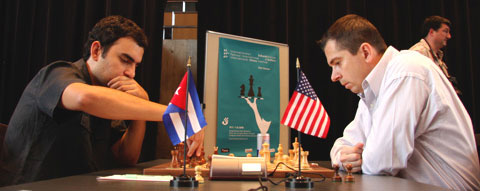
It was the US vs Cuba, the super-solid GM Alexander Onischuk vs the young-and-ambitious Leinier Dominguez Perez, who went on the offensive on the black side of a Grünfeld Russian System. But Onischuk hung on and traded down to a drawn rook and knight vs rook ending. That is where the action began...
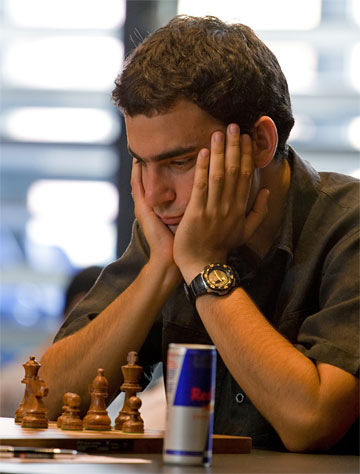

Cuban GM Leinier Dominguez at the start of round six

Onischuk,Al (2670) - Dominguez Perez,L (2708) [D97]
41st Festival GM Biel SUI (6), 26.07.2008
1.d4 Nf6 2.c4 g6 3.Nc3 d5 4.Nf3 Bg7 5.Qb3 dxc4 6.Qxc4 0-0 7.e4 a6 8.Be2 b5 9.Qb3 c5 10.dxc5 Bb7 11.e5 Nfd7 12.Be3 e6 13.Rd1 Qc7 14.0-0 Nxc5 15.Qa3 Ncd7 16.Qe7 Rc8 17.Ng5 Nf8 18.Qxc7 Rxc7 19.f4 h6 20.Nf3 Nc6 21.Nd4 g5 22.Nxc6 Bxc6 23.fxg5 hxg5 24.Bxg5 Bxe5 25.Bf3 Rac8 26.Bxc6 Rxc6 27.Bf6 Bxf6 28.Rxf6 Rc4 29.a3 Kg7 30.Rf2 f5 31.Rd6 R8c6 32.Rxc6 Rxc6 33.g4 fxg4 34.Rg2 Ng6 35.Rxg4 Kf6 36.Kf2 Ne5 37.Rf4+ Kg6 38.Ke2 Nc4 39.Ne4 Nxb2 40.h4 Nc4 41.Rf6+ Kh5 42.Ng5 Nxa3 43.Nxe6 Rc2+ 44.Kd3 b4 45.Rf5+ Kg6 46.Rc5 Rf2 47.Nd4 b3 48.Nxb3 Rf3+ 49.Ke4 Rxb3 50.Rc6+ Kh5 51.Rxa6 Nc4 52.Ra8 Nd2+ 53.Kd4 Kxh4
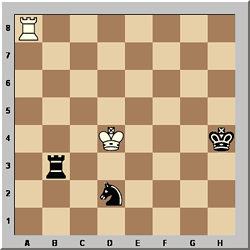
The position, Fritz tells us after due consultation of the endgame tablebases, is a draw – completely and theoretically. But Cuban GM Leinier Dominguez plays on, testing his US American opponent's ability to play it perfectly. 54.Rg8 Nf3+ 55.Kc4 Rb1 56.Kd5 Ng5 57.Ke5 Kg4 58.Kd4 Rd1+ 59.Ke5 Re1+ 60.Kd5 Re7 61.Kd4 Kf5 62.Rf8+ Nf7 63.Ra8 Kf4 64.Rf8 Rd7+ 65.Kc5 Ke4 66.Ra8 Rc7+ 67.Kb4 Kd4 68.Kb3 Ne5 69.Rd8+ Nd7 70.Kb2 Kd3 71.Rh8 Rb7+ 72.Kc1 Nc5 73.Rh3+ Kd4 74.Kc2 Rc7 75.Rh4+ Ne4+ 76.Kb3 Rc8 77.Kb2 Rg8 78.Kb3 Rg2 79.Kb4 Rb2+ 80.Ka3 Rb8 81.Ka4 Kd5 82.Ka3 Nc5 83.Ka2 Ne6 84.Ka3 Nd4 85.Rh7 Rb6 86.Ka2 Kc4 87.Rc7+ Kd3
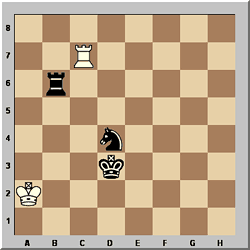
Dominguez has used 34 of the 50 moves available for his experiment, Onischuk has handled the position flawlessly. Now comes the catastrophe: 88.Rd7?? Allows mate in eight! 88...Kc2 89.Ka3 Nc6 90.Ka4 Rb4+ 91.Ka3 Rb5 and White will be mated in four more moves. 0-1. [Click to replay]
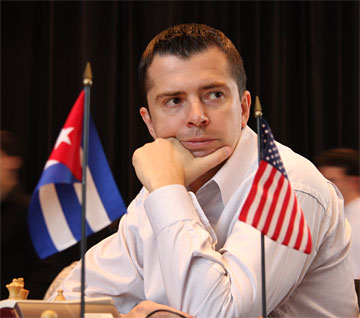

Cuba vs USA in flags: American GM Alexander Onischuk


Magnus Carlsen was clearly thirsting for another victory and went after tournament tail-ender Yannick Pelletier of Switzerland in his usual active, aggressive fashion. It is amazing how grown GMs crack under this pressure from a 17-year-old.
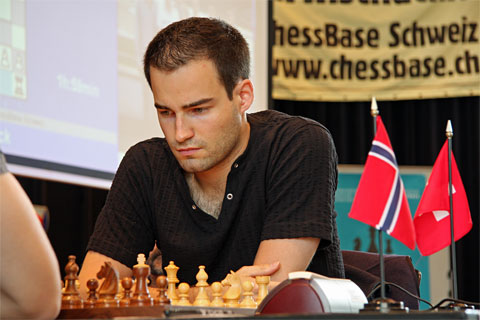

Yannick Pelletier in this match between Switzerland (41,285 km², 7.6 million inhabitants, 181.4 per km²) and Norway (385,000km², 4.7 million inhabitants, 12 per km²)

Pelletier,Y (2569) - Carlsen,M (2775) [E15]
41st Festival GM Biel SUI (6), 26.07.2008
1.d4 Nf6 2.Nf3 e6 3.c4 b6 4.g3 Ba6 5.b3 Bb4+ 6.Bd2 Be7 7.Bg2 d5 8.cxd5 exd5 9.Nc3 0-0 10.0-0 Bb7 11.Rc1 Nbd7 12.Bf4 c6 13.Qc2 Re8 14.Rcd1 Bb4 15.Bd2 Rc8 16.Qb2 Qe7 17.Rfe1 Qf8 18.Bh3 Rcd8 19.Qc2 h6 20.Nh4 c5 21.Nf5 a6 22.Qb2 Bxc3 23.Bxc3 Ne4 24.dxc5 Nxc3 25.Qxc3 bxc5 26.Qa5 Nf6
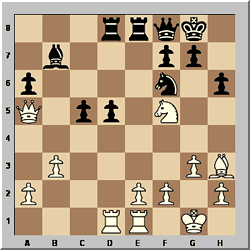
Up until here Yannick Pelletier has been hanging on against Magnus Carlsen's Queen's Indian, by the skin of his teeth. But now the pechvogel (German for unlucky bird) of this tournament, makes a fatal mistake: 27.Qb6? He could have played 27.Rc1 or 27.Bg2. Now Magnus can go into full attack mode, where the lad is ruthless. 27...Bc8 28.Kg2 Ne4 29.f3 Ng5 30.g4 h5 31.Rc1 g6 32.Ng3 Nxh3 33.Kxh3 hxg4+ 34.fxg4 Qh6+ 35.Kg2 Bxg4 36.Qxc5 Re3 [an alternative was 36...Rc8 37.Qa3 Rxe2+ 38.Rxe2 Rxc1+–] 37.Qd4
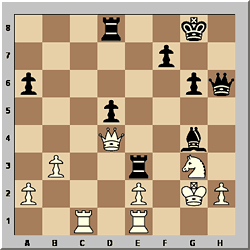
And thus it ended: 37...Qh3+ 38.Kg1 Rxg3+ 39.hxg3 Qxg3+ 40.Kh1 Bf5 0-1. [Click to replay]
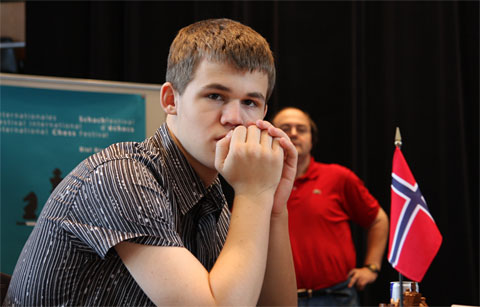

Back in the sole lead: Magnus Carlsen in round six


Etienne Bacrot sacrificed a pawn on move 15 against tournament leader Evgeny Alekseev, without however showing what compensation he had received from it. For a long time it looked as though Alekseev might win and stay in the lead with Magnus Carlsen. A comfortable draw at least seemed to be on the cards. But then Blunder struck.

Bacrot,E (2691) - Alekseev,Evgeny (2708) [E00]
41st Festival GM Biel SUI (6), 26.07.2008
1.d4 Nf6 2.c4 e6 3.g3 Bb4+ 4.Bd2 Be7 5.Nf3 d5 6.Qc2 0-0 7.Bg2 c6 8.0-0 Nbd7 9.Rd1 b6 10.b3 Ba6 11.Bf4 Rc8 12.Nc3 Nh5 13.Bc1 Nhf6 14.Bb2 Qc7 15.Rac1 dxc4 16.bxc4 Bxc4 17.Ne5 Nxe5 18.dxe5 Nd5 19.Ne4 b5 20.Nd6 Bxd6 21.exd6 Qd7 22.a4 f6 23.Ba3 Nb6 24.a5 Na4 25.Rd4 Bd5 26.Bc5 Bxg2 27.Kxg2 e5 28.Rd2 Rfd8 29.Qb3+ Qf7 30.Qe3 Rd7 31.a6 h6 32.f3 Qe6 33.Bxa7 Ra8?
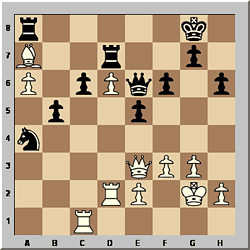
It is not easy to see why the last move is losing, but Etienne Bacrot works it all out: 34.Rxc6 Raxa7 35.Qd3 b4 36.Rc8+ Kf7 37.Qh7 f5 38.Qg8+ Kf6 39.Rf8+ Rf7 40.Rxf7+ Rxf7
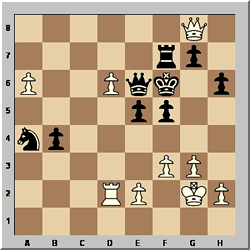
Black is a piece up and completely lost. With the two passed pawns on the sixth White could even play a move like 41.Qxf7 to win. Bacrot has an even more convincing finish: 41.Qd8+ Kg6 42.d7 Nc5 43.Qe8 1-0. [Click to replay]
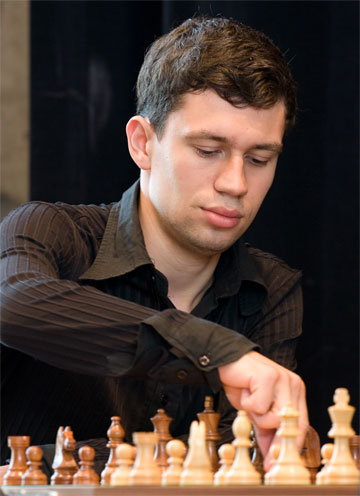

Slipped to third place: GM Evgeny Alekseev of Russia

Current standings

Magnus Carlsen now leads alone, with a 2843 performance that puts him at number two in the world on the live rating list, just a point and a half behind top GM Vishy Anand. Carlsen and Leinier Dominguez are the only players left who have not tasted defeat in this tournament. The tragic figure is Swiss GM Pelletier, who has scored a total of half a point in six games and is performing at a 2305 level. Wake up, Yannick!

Friday, July 18, 2008

CHESSBASE: KARPOV CUP

Four players tie for first at Karpov Poikovsky tournament
17.07.2008 – The event, named to honour its patron Anatoly Karpov, saw firebrand Alexei Shirov take the sole lead after seven rounds, only to lose fairly traumatically to Vugar Gashimov, a soon-to-be 22-year-old grandmaster from Azerbaijan. All other games were drawn, as were all five games of the final round. In the end Rublevsky, Jakovenko, Gashimov and Shirov shared first. Results, games and statistics.

9th Karpov Tournament in Poikovsky

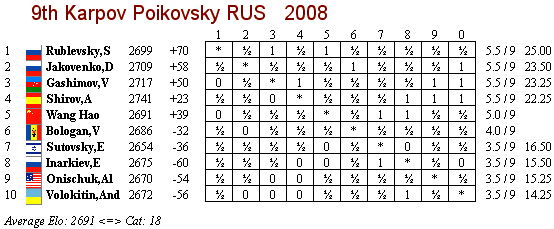
The 9th Karpov tournament took place from July 8th to 17th 2008 in Poikovsky. The average rating of the participants was 2691, making it a category 18 event.

After seven rounds of play Alexei Shirov was in the sole lead, with 5.0 points, followed half a point behind by two grandmasters, Dmitrij Jakovenko and Sergei Rublevsky (who had led the tournament before that). In round eight all games were drawn, except one: Alexei Shirov lost rather traumatically to Vugar Gashimov. That pushed the Latvian-Spanish GM into a cluster of four players, with Gashimov ascending to the same group.

In the final round all games were drawn (two in less than 20 moves), leaving everything as it was on the previous day. The finals standings for the tournament were as follows:

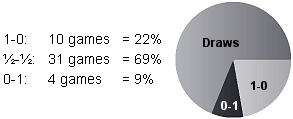
The draw average was 69%, up from 63% after the first seven rounds. White won a total of ten games, Black was successful in a total of four.

In our previous coverage of the event we gave a link to the "Russian Chess" web site, which had English language information. Unfortunately the page had malware attached to it, as a number of readers pointed out just minutes after we had published our report. The page attempted to download code with suspicious functionality. This could include trojans, link to other infected pages, or spyware to spoof the content of a banking site. It need not be the case – there are some innocent pieces of code that may look like malware to the heuristic detection routines of a virus protector, but in the interest of our readers we of course immediately removed the link. The brave and technically advanced amongst you can visit the site – www dot ruschess dot com – and check what is causing the alarms. To the readers who were close to cardiac arrest when their virus or zone alarms popped up we sincerely apologise.

Links

The games are being broadcast live on the above sites and on the chess server Playchess.com. If you are not a member you can download the free PGN reader ChessBase Light, which gives you immediate access. You can also use the program to read, replay and analyse the PGN games.

Thursday, July 17, 2008

CHESSVILLE: BISHOP OFF-SIDE

by IM Igor Khmelnitsky
You could study the following material either by skipping the test and going directly to the lecture, or start by attempting to figure out on your own what is going on in each of the positions I will be talking about and then proceed to the lecture. If you chose the latter, spend 5-15 minutes on each diagram and record your evaluation and move / plan for the side whose turn it is and sample variations. Then compare your ideas with mine. Let me know how you like the test and the lecture.

Test yourself


All Positions:

1. Check whose move it is.

2. Evaluate position (i.e. White is Better, or Black is Winning, or Equal...)

3. Find the Best move and, if necessary, support it with variations.

4. Answer the question (if there is a specific one)


1. White to Move


IM Igor Khmelnitsky

Igor is a winner of many national and international tournaments in Europe and the United States. At various points during his career, he has won individual encounters with many of the game’s best players - including Lev Alburt, Boris Alterman, Viorel Bologan, Roman Dzindzikhashvili, Vasily Ivanchuk, Alexander Ivanov, Oleg Romanishin, Alexander Shabalov, Evgeniy Sveshnikov, Patrick Wolff, and Alex Yermolinsky. In total, Igor has beaten over 30 different Grandmasters. He has been a participant in the Ukrainian National Championship as well as a three times contestant in the US National Championship.

2. White to Move 3. Black to Move
4. Black to Move 5. Black to Move

Bishop Off-Side

The subject of today’s mini-test is a misplaced bishop. The first two positions should be extremely easy for all, except for true novices.

6. White to Move

STOP - Lecture begins below.

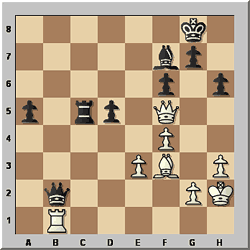
#1. Training position (Khmelnitsky). White is winning the bishop for the pawn after 1.Pf4-f5. The bishop is trapped and attacked by a less valuable piece.

Similar situations often occur in games of novices when the B pins the N (for example Bc8-g4 pinning Nf3) and then is attacked consequently by pawns h and g (or a and b).


1. White to Move


2. White to Move

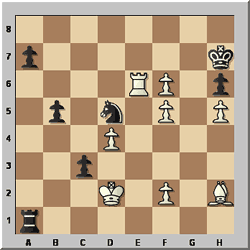
#2. Training position (Khmelnitsky). White is winning the bishop once again. This time he plays 1.Pb2-b3 cutting the escape route and preparing 2.Kc1-b2. Unlike in the example #1, here Black has a move before his bishop will be attacked. Yet, there is no move that could help.

Similar situations often occur in games of novices when B grabs the pawn on the R file (a or h). Note, that if the black pawn a7 was on a5, Black could play 1...Pa5-a4 2.Kc1-b2 Pa4xb3 3.Pc2xb3. Now the B is protected by the Ra8. Black would have to move the Ra8 to a5, a6 or a7 to free the square for the other rook in anticipation of 4.Rd1-a1.

#3. Training position (Khmelnitsky). Black is able to trap the bishop after 1...Pb6-b5. The direct plan is to run with the king to attack the trapped bishop and win it. The white king can't help the bishop and various attempts to open up the king-side fail as well. Black wins in all lines. Here are some sample variations:

2.Kf4-e3 Ke7-d7 3.Ke3-d3 Kd7-c7 4.Kd3-d4 Kc7-c6, or 2.Pg4-g5 Ph8-h6 freezing the K-side, or 2.Ph5-h6 Pg7xh6 3.Kf4-g3 (3.Kf4-f3 Ke7-d7 4.Kf3-g2 Kd7-c6 5.Kg2-h3 Kc6-b6) 3...Ph6-h5! If interested, please practice with a friend or computer.


3. Black to Move


4. Black to move

#4. This example is from the game Lautier,J - Bauer,C, Championnat de France, 2006. The B on a6 is trapped and is about to be lost. Black is winning. However, you get no points for hasty 1...Rbb6? as after 2.Ba6-c8, the B escapes. Instead, Black played 1....Be8-d7 gaining control over c8. White is losing the bishop for a pawn. For example, 2.Kg1-f2 Rb8-b6 3.Ba6xb5 Rb6xb5 4.Ra3xa7 Rb5xd5.

#5. This training position (Khmelnitsky), is truly amazing in its unexpected simplicity. Looks like White is the one who has the initiative and probably a small advantage. However, after 1...Re8-b8, it is Black who has the winning position. The Ba6 is once again under arrest. White has no good counterplay against Black's plan of sending the king to b6 and then bringing another attacker - the rook on a8, to win the trapped bishop.

Examples 3-5 show you that squares a6, a3, h3, h6 are often not safe for the bishop, when the escape route is (or can be) cut off. The pawn b5 was such a barrier in these examples.


5. Black to Move

#6. Finally, the last position is there to remind you that even on the open board, the bishop may have problems finding a safe spot.


6. White to Move

In this study by Reti (1922), White is winning. He has many moves and your head may start spinning when you try to calculate all possible variations. My suggestions would be - when you don't see a knock-out punch, stop for a moment and ask yourself this questions - what would he do if I did nothing? In this particular position - Black has no useful move. All bishop's moves allow fork with the knight (ex. 1...Bh6-g7 2.Nd4-e6+). Another fork is available after 1...Kc5-d6 - 2.Kd4-f5+. And the remaining king's moves allow the pawn to get through. Hence comes the quiet 1.Kg2-h1 putting Black in zugzwang and winning.

When you don't see a knock-out punch, stop for a moment and ask yourself this question - "what would he do if I did nothing?"

===================================================================

Summary: a bishop is a long ranged piece and needs open space to show its strength in attack. On defense, a bishop is often a solid force as well. Depending on its placement, a bishop's range is anywhere from 7 (ex. from a1, a7) to 13 (ex. from d4 or e5) available squares. When some of these squares become unavailable, the bishop can get into trouble as in the examples shown above. Memorize these typical ideas. Also, remember, that merely trapping the bishop may not be enough to succeed. Two common options - find a way to attack and win the trapped bishop giving you material advantage (examples 1-5) or start actions away from the bishop so it can't participate giving a virtual material advantage (see example in this article).

Tuesday, July 15, 2008

Benjamin Franklin on Chess

"Chess teaches foresight, by having to plan ahead; vigilance, by
having to keep watch over the whole chess board; caution, by having to
restrain ourselves from making hasty moves; and finally, we learn from
chess the greatest maxim in life - that even when everything seems to
be going badly for us we should not lose heart, but always hoping for
a change for the better, steadfastly continue searching for the
solutions to our problems."

Benjamin Franklin (1706-1790)
Statesman, philosopher, inventor, scientist, musician, economist

Friday, July 11, 2008

SHELL's TOP 8 UNDER

Shell National Youth Active Chess Honors NCR Leg’s Top Youngest Player (8 Under)
10/07/2008

Daryl Unix Samantila of Adamson University emerged as the winner of the 8 year-old and under category during the seven-round Swiss System tournament of the 16th Shell National Youth Active Chess Championship – National Capital Region Leg held recently at SM City Manila.

Wednesday, July 9, 2008

CHESSBASE: KARJAKIN - SHORT

Kiev Life Rapid: Karjakin Beat Short 7.5:2.5
08.07.2008 – They worked together in Nigel's home in Greece, and almost got themselves killed in a traffic accident. But Sergey Karjakin, 25 years younger than Nigel Short, completely outmatched him in the rapid chess match in the Academic Puppet Theatre in Kiev, Ukraine. On the final day the youngster won both games to finish with a five-point lead. Illustrated report.

From 3rd to 7th of July, 2008 British Grandmaster Nigel Short, former World Championship challenger, and Sergey Karyakin, who at twelve became the youngest grandmaster in history, played a ten-game rapid chess match in Kiev (Kyiv). The venue was the Kyiv Academic Puppet Theatre, Grushevskogo Str., 1a, Kyiv. this is the oldest puppet theatre in Ukraine, established in 1927, and today pays host to puppet theatres from all over the world.

Day five – final

Karjakin,Sergey (2727) - Short,N (2655) [D37]
Rapid Match Kiev UKR (9), 07.06.2008
1.d4 Nf6 2.Nf3 d5 3.c4 e6 4.Nc3 Be7 5.Bf4 0-0 6.e3 c5 7.dxc5 Bxc5 8.Qc2 Nc6 9.a3 Be7 10.cxd5 exd5 11.Be2 Be6 12.0-0 Rc8 13.Rfd1 a6 14.Ne5 Qb6 15.Nxc6 Rxc6 16.Be5 Ne4 17.Qb1 Nxc3 18.Bxc3 Rd8 19.Bf3 h6 20.h3 Qc7 21.Qd3 Bd6 22.Rd2 f6 23.Rad1 Bh2+ 24.Kh1 Be5 25.Bd4 Rc4 26.Qb3 b5 27.Be2 Rc6 28.a4 bxa4 29.Qxa4 Rb8 30.f4 Bxd4 31.Qxd4 a5 32.Bf3 Rb4 33.Qd3 Rc5 34.Qb1 Qb7 35.Rc1 Qb6 36.Rcd1 Qb7 37.Kh2 Qb5 38.Qg6 Bf7 39.Qf5 Rxb2 40.Rxb2 Qxb2 41.Rb1

Black should be able to hold this position, if only he finds the drawing move: 41...g6! In this rapid chess game Nigel Short doesn't: 41...d4?? 42.Rxb2 (42.Bd5 was an interesting alternative: 42...Qxb1 43.Bxf7+ Kxf7 44.Qxb1) 42...Rxf5 43.Rb8+ Kh7 44.Be4 (the skewer) 44...Bg6 45.Bxf5 Bxf5 46.exd4 a4 47.Ra8 Bd7 48.d5 Kg6 49.Ra7 1-0.


Short,N (2655) - Karjakin,Sergey (2727) [C78]

Rapid Match Kiev UKR (10), 07.06.2008
1.e4 e5 2.Nf3 Nc6 3.Bb5 a6 4.Ba4 Nf6 5.0-0 Bc5 6.c3 b5 7.Bb3 d6 8.d4 Bb6 9.Be3 Bg4 10.d5 Bxe3 11.fxe3 Ne7 12.Nbd2 0-0 13.Qe1 c6 14.dxc6 Nxc6 15.Nh4 Na5 16.Qg3 Nxb3 17.axb3 Bh5 18.b4 Bg6 19.Nxg6 hxg6 20.Qh4 d5 21.exd5 Nxd5 22.Qf2 a5 23.bxa5 Rxa5 24.Rad1 Qa8 25.Ne4 Ra6 26.Qf3 Nf6 27.Nxf6+ gxf6 28.e4 Qc6 29.h4 Qb6+ 30.Rf2 Rd8 31.Rdf1 Kg7 32.g4 Rd2 33.Kg2 Rxf2+ 34.Rxf2 Qe6 35.g5 fxg5 36.hxg5 b4 37.Qh3 Qc4 38.Qf3 bxc3 39.bxc3 Rc6 40.Kh2 Qb3 41.Kg2 Kg8 42.Rd2 Rxc3 43.Qf2 Qe6 44.Qh4 Rc8 45.Qg3 Kg7 46.Rd5 Rc2+ 47.Kh1 Qb6 48.Rd1 Qb2 49.Qh3 Rc1 50.Qf1 Rxd1 51.Qxd1 Qf2 52.Qg4 Qf4 53.Qg2 Kf8 54.Kg1 Ke7 55.Kh1 Kd6 56.Kg1 Kc5 57.Kh1 Kd4 58.Qb2+ Kxe4 59.Qc2+ Kd5 60.Qb3+ Kd6 61.Qb6+ Ke7 62.Qc5+ Ke6 63.Qc8+ Kd6 64.Qd8+ Kc5 65.Qa5+ Kc4 66.Qa4+ Kd5 67.Qa8+ Kd4 68.Qa4+ Ke3 69.Qb3+ Kf2 70.Qc2+ Kg3 71.Qf2+ Kg4 72.Qg2+ Kf5 73.Qh3+ Kxg5 74.Qg3+ Kf6 0-1.


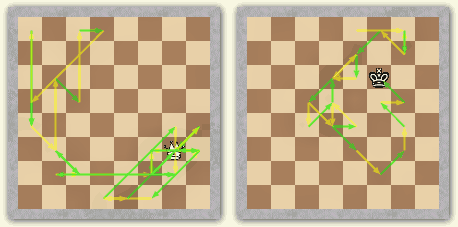
The path of the white queen, and how the black king managed to escape its checks

Monday, July 7, 2008

CHESSBASE: DORTMUND SPARKASSEN

Leko Wins Sparkassen Meeting
06.07.2008 – Peter Leko, who was in the lead after the penultimate round, drew his game in 31 moves. Since his closest rivals, Ian Nepomniachtchi and Jan Gustafsson drew their game (in 22 moves) Leko became the sole winner with his plus two score. The shocker came when Vladimir Kramnik stumbled against Ivanchuk to end in seventh place. Final report.

The Sparkassen Chess Meeting took place from June 28rd to July 6th, 2008, in the Dortmund Civic Theater, with eight players competing in a single round robin. The average rating was 2695, making the event a Category 18 tournament.

Round 7: Sunday, July 6, 13:00h
Vassily Ivanchuk
1-0
Vladimir Kramnik
Loek van Wely
0-1
Shak. Mamedyarov
Peter Leko
½-½
Arkadij Naiditsch
Ian Nepomniachtchi
½-½
Jan Gustafsson

Leko,P (2741) - Naiditsch,A (2624) [C89]
Sparkassen Dortmund GER (7), 06.07.2008
1.e4 e5 2.Nf3 Nc6 3.Bb5 a6 4.Ba4 Nf6 5.0-0 Be7 6.Re1 b5 7.Bb3 0-0 8.c3 d5 9.exd5 Nxd5 10.Nxe5 Nxe5 11.Rxe5 c6 12.d3 Bd6 13.Re1 Bf5 14.Qf3 Qh4 15.g3 Qh3 16.Bxd5 cxd5 17.Qxd5 Rad8 18.Qg2 Qxg2+ 19.Kxg2 Bxd3 20.Be3 Be4+ 21.f3 Bc6 22.Nd2 Rfe8 23.Bd4 Rxe1 24.Rxe1 f6 25.Kf2 h5 26.Ne4 Bf8 27.Re2 Kf7 28.Nc5 Bxc5 29.Bxc5 Rd7 30.Bd4 a5 31.b3. White is a pawn up, but with opposite coloured bishops the position is hardly more than a draw. ½-½.


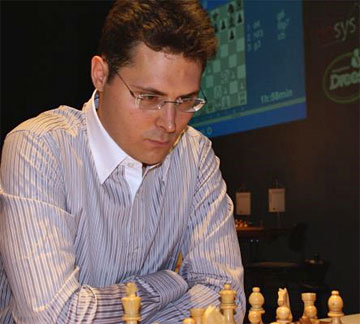
The winner of Dortmund 2008: Peter Leko of Hungary


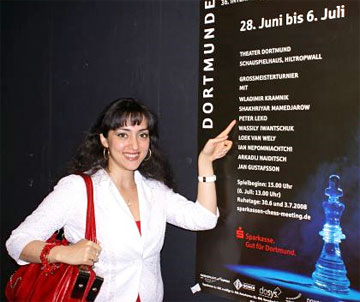
She has picked the winner: wife Sofi Leko

Nepomniachtchi,I (2634) - Gustafsson,J (2603) [C77]
Sparkassen Dortmund GER (7), 06.07.2008
1.e4 e5 2.Nf3 Nc6 3.Bb5 a6 4.Ba4 Nf6 5.d3 b5 6.Bb3 Bc5 7.Nc3 d6 8.Nd5 h6 9.c3 Be6 10.Nxf6+ Qxf6 11.Be3 Bxb3 12.axb3 Bxe3 13.fxe3 0-0 14.0-0 Qe6 15.Nh4 Ne7 16.Nf5 Kh7 17.b4 Ng8 18.Qc2 g6 19.Ng3 c5 20.bxc5 dxc5 21.d4 c4 22.Rf3 ½-½.


Jan Gustafsson and Ian Nepomniachtchi analyse a game in which neither had shown a fanatical interest in trying to catch up with the leading Leko

Van Wely,L (2677) - Mamedyarov,S (2752) [D38]
Sparkassen Dortmund GER (7), 06.07.2008
1.Nf3 Nf6 2.c4 e6 3.Nc3 d5 4.d4 Bb4 5.cxd5 exd5 6.Bg5 Nbd7 7.Qc2 h6 8.Bh4 0-0 9.e3 c5 10.Bd3 c4 11.Bf5 Nb6 12.g4 g5 13.Bg3 Bxf5 14.gxf5 Ne4 15.Nd2 Qe7 16.Ke2 Nxd2 17.Kxd2 Qe4 18.h4 g4 19.Qxe4 dxe4 20.h5 Kh7 21.Rh4 Rg8 22.Rg1 Nd5 23.Be5 f6 24.Bh2 Rac8 25.Rhxg4 Rxg4 26.Rxg4 Rc6 27.Rxe4 Ra6 28.a3 Bxc3+ 29.bxc3 Rxa3 30.Re6 b5 31.e4 Ra2+ 32.Ke1 Nxc3 33.e5 Ra1+ 34.Kd2 Nd5 35.exf6 c3+

White should be able to hold the draw in this position, but not with: 36.Kd3? Rd1+ 37.Ke2?? The answer is we haven't the foggiest idea. Time trouble? This just hasn't been Loek's tournament. 37...c2 38.f7 Kg7 39.Rxh6 Kxf7 (or 39...c1Q+++–). 0-1.

Ivanchuk,V (2740) - Kramnik,V (2788) [C42]
Sparkassen Dortmund GER (7), 06.07.2008
1.e4 e5 2.Nf3 Nf6 3.Nxe5 d6 4.Nf3 Nxe4 5.d4 d5 6.Bd3 Nc6 7.0-0 Be7 8.Re1 Bg4 9.c4 Nf6 10.Nc3 Bxf3 11.Qxf3 Nxd4 12.Qd1 Ne6 13.cxd5 Nxd5 14.Bb5+ c6 15.Nxd5 cxb5 16.Qh5 0-0 17.Nxe7+ Qxe7 18.Qxb5 Rfd8 19.Be3 a6 20.Qb3 Rac8 21.h3 h6 22.Rad1 Rxd1 23.Rxd1 b5 24.Rd3 Rc6 25.Qd5 Qe8 26.Rd2 Qc8 27.b3 Rc3 28.h4 a5 29.Rd1 Rc2 30.Qxb5 Rxa2 31.h5 Nf8 32.Rd4 Qc7 33.Rd1 Rb2 34.Rc1 Qd7 35.Qb8 Rc2 36.Ra1 Qf5 37.Qd8 Qxh5 38.Rxa5 Qg4 39.Ra4 Qd7 40.Rd4 Qb7 41.b4 Rb2 42.Bd2 Rb1+ 43.Kh2 Qb5 44.Qd5 Qe2 45.Be3 Ng6 46.Qf5 Qf1 47.Kg3 Rb3 48.Re4

Black should be able to defend, probably best with 48...Qh1. However at the end of a long battle Kramnik falters: 48...Nf8?? This allows 49.Rf4, which threatens 50.Qxf7, forking the rook and the knight, for which there is no reasonable defence. 1-0.


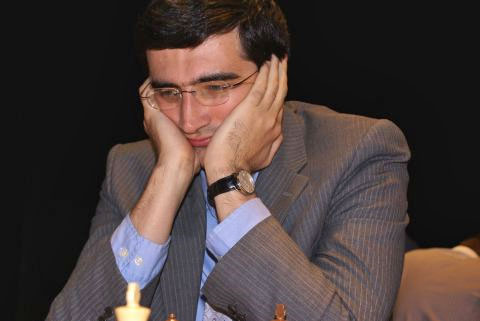
After a total of eight Dortmund wins a traumatic loss: Vladimir Kramnik [Photos: Dagobert Kohlmeyer]

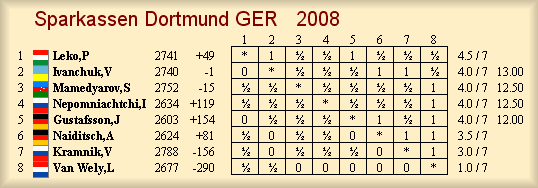
Final standings

Peter Leko finished at plus two, a score experts predicted would be sufficient to win this event alone. Leko's performance: 2790. In joint second we find Ivanchuk, Mamedyarov, Nepomniachtchi and Gustafsson, all at plus one. Arkadij Naiditsch finished at 50%, which was better than could be expected from his rating. In a startling seventh place with minus one and a 2632 performance we find Vladimir Kramnik, who won Dortmund a record eight times in the past (1995, 1996, 1997, 1998, 2000, 2001, 2006 and 2007).

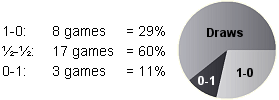
Draw statistics

Saturday, July 5, 2008

NM BERNADINO

National Master MARLON BERNARDINO played a simul match at the MERALCO with the junior players of the MERALCO Chess Club and the La Salle Green Hills Grade School and High School Chess Team participating.

Joel BILADO of MERALCO Chess Club and Gio MEJIA of La Salle Green Hills posted inspiring victories.


Tuesday, July 1, 2008

CHESSDOM: CARLSEN WINS AEROSVIT

The last round game between Sergey Karjakin and Magnus Carlsen was a short but exciting affair. Karjakin wanted to avoid Sicilian Dragon this time and opened with 1.d4, to which Carlsen replied with Gruenfeld Indian defence. White sacrificed a pawn to force dark-squared Bishops exchange and stormed against Black weakened King. Carlsen had to defend for a while, but after the Queen's trade, the resulting position was roughly equal ending and players agreed to draw on 29th move.

After the starting two points from two rounds and disastrous streak in the middle of the tournament, Alexei Shirov won the last two games and reached 50% score. Andrei Volokitin found the key against Berlin Ruy Lopez lock and beat Evgeny Alekseev. He earlier lost in the same variation to compatriot Pavel Eljanov. See GM Mikhail Golubev's excellent game analysis on the official website. Hans Arild Runde updated his "Measure Up" column by including Foros Aerosvit results into July rating list projection. Henrik Carlsen provided plenty of interesting information on his blog.

Round 11 results:
Svidler, Peter ½ - ½ Van Wely, Loek
Ivanchuk, Vassily 1 - 0 Eljanov, Pavel
Karjakin, Sergey ½ - ½ Carlsen, Magnus
Volokitin, Andrei 1 - 0 Alekseev, Evgeny
Jakovenko, Dmitry ½ - ½ Nisipeanu, Liviu-Dieter
Onischuk, Alexander 0 - 1 Shirov, Alexei

Final standings:
1. Magnus Carlsen 2765 - 8.0
2. Vassily Ivanchuk 2740 - 7.0
3-4. Sergey Karjakin 2732 and Pavel Eljanov 2687 - 6.0
5-7. Dmitry Jakovenko 2711, Alexei Shirov 2740 and Andrei Volokitin 2684 - 5.5
8-10. Liviu-Dieter Nisipeanu 2684, Peter Svidler 2746 and Evgeny Alekseev 2711 - 5.0
11. Loek Van Wely 2676 - 4.0
12. Alexander Onischuk 2664 - 3.5